Category: News

  • Science news from the far North

    Science news from the far North

    ScienceNordic is a news service with science news in English covering the Nordic countries. Two Nordic science media, one Danish and one Norwegian, have joined forces to launch ScienceNordic.

    From today you can get updated on news from Nordic science: http://sciencenordic.com/

    • When a glacier calves into the ocean scientists see the same patterns that are found in brain impulses
    • Norwegians are still in a state of shock. How will the terrorist attacks on July 22 change the country?
    • Male circumcision leads to a bad sex life, according to new study.
    • Your smartphone can scan your brain, if you install the new Danish app.
    • How did a French, 13th century gold ring end up in inside a stone wall on a small Norwegian island?

    You can also subscribe to the ScienceNordic newsletter: sciencenordic.com/newsletter

    The Norwegian Minister of Research and Higher Education Tora Aasland, who opened ScienceNordic.com, says she expects the new portal to make Nordic research more visible on the global arena.

    The international science press is dominated by news from Anglo-American research institutions and periodicals –because they are published in English. But the scientific results created in the Nordic countries are just as strong and newsworthy, and ScienceNordic will report on them.

    “This leaves a huge gap in the market for science news from the region, communicated to a broader audience in English. We intend to fill this gap,” says Vibeke Hjortlund, editor-in-chief at Videnskab.dk.

    “We will, naturally, focus our efforts on areas where Nordic researchers have their particular strengths. This includes areas such as green technology, climate and the environment, oil and offshore technology, biotechnology, gender equality and the welfare state and its economy, says Nina Kristiansen, editor-in-chief at Forskning.no.

    ScienceNordic will target the academic environment, the business community, international organisations and decision-makers with interests in scientific development, science journalists and members of the general public with a strong interest in science.

    ScienceNordic will cover Denmark, Norway, Sweden, Finland and Iceland – with an eye on Greenland, the Faroe Islands and Åland which are also part of the Nordic region.

    Nordforsk, The Ministry of Education and Research in Norway and The Ministry of Science, Innovation and Higher Education in Denmark has provided funds to establish ScienceNordic.

    Sincerely,
    Vibeke Hjortlund, editor-in-chief at Videnskab.dk,
    mail vh@videnskab.dk ,
    phone +45 4050 7765

    Nina Kristiansen, editor-in-chief at Forskning.no,
    mail nina@forskning.no,
    phone +47 4145 5513

  • NPG offers travel Grants to attend ESOF 2012

    NPG offers travel Grants to attend ESOF 2012

    Nature Publishing Group has supported Euroscience Open Forum (ESOF) since its very first edition in 2004. Once again, NPG has generously offered to support ESOF by funding travel grants for journalists to attend ESOF2012 in order to increase the impact of ESOF. ESOF2012 takes place in Dublin, July 11-15 2012.

    Presentation and conditions for travel grant.

  • Rainy summer’s days in Heidelberg

    Rainy summer’s days in Heidelberg

    Heidelberg Study Trip ParticipantsIn July fifteen EUSJA-journalists made visit to the European Molecular Biology Laboratory (EMBL) and the German Cancer Research Centre (DKFZ) in Heidelberg (Germany). The programme of the three-day-tour was highly scientific, full of interesting lectures, mind-boggling movies and experiments – and a lot of unpublished data.

    The EMBL’s Advanced Training Centre, which is situated on a wooded hill just outside Heidelberg, has an eye-catching architecture. The centre, which was opened in March 2010 and which houses the administrative part of the EMBL, looks a little bit like the Guggenheim Museum in New York – it also has a pathway on the inside wall that slowly spirals up. But after a closer look, you see that it’s definitely not a copy. This builing is totally unique. To emphasize the mission of the EMBL – basically to learn more about molecular biology – the pathway is designed as a double helix. Double helix… that rings a bell, doesn’t it? Of course, it’s the basic structure of DNA that is at the heart of this spectacular architectural achievement. And because there are two spiraling pathways – just like the two intertwined DNA strains – it’s possible to take two different paths to the top floor of the building. Luckily for the people working here, there are some interconnections between the pathways (the hydrogen bonds?) which offer an escape route just in case you’re on the wrong helix.

    On Monday, scientists working at EMBL gave exciting lectures about their work. At the heart of these lectures were tough questions like ‘How unique is my own DNA?’, ‘What about personalized medicine?’ and ‘How long will it take before every cancer patient gets a personalized treatment?’. The scientists at EMBL sure know how to give a lecture without overwhelming their audience with to much numbers or data. In many cases a nice picture or even a movie is enough to grasp the attention of all the journalists. For example in a movie Darren Gilmour showed how groups of cells migrate by following a ‘leader cell’. Unfortunately there’s no link to this movie on Gilmour’s webpage on the EMBL site (somebody?).

    Monday afternoon we got an insight in the labs of EMBL, where all the work – which was presented in such a nive way during the lectures – is done. Personally I find these laboratory tours rather unexciting: no more than a good opportunity to stretch the legs. I’v seen many biology and physics labs, and to me they look all more or less the same.

    Day two. On Tuesday the bus took us downtown Heidelberg, to the – also – brand new building of the German Cancer Research Centre, or DKFZ (Deutsches Krebsforschungszentrum). Because health and cancer research is not in my specialization as a science journalist, I was very curious to this visit – as a layman. Again the programme of the day was fully packed with lectures, and once more these lectures were all very nicely presented and full of interesting ideas – and because the topic is cancer: full of hope. For example the parvoviruses which Jörg Schlehofer talked about – could they become a new wonder treatment for brain tumors? – or the involvement of stem cells in the growth of tumors (by Andreas Trumpp). This day was concluded with a visit to the National Centre for Tumor Diseases, where patients from all over Germany are treated and supported in a highly personalized way (instead of personalized medicine, they get personalized care).

    Tuesday evening all the participating journalists, together with the scientists from EMBL and DKFZ, were invited to embark on a little boat named Germania (pronounce in a very loud and strict way). During this meet-the-scientists-session we sailed downstream the river Neckar, passing three of four enclosures. Luckily the weather was quite dry on that evening – so we could drink and eat on the back and front deck of the ship.

    Wednesday morning the bus took us back to the EMBL, for three more lectures, now presented by pairs of scientists – one from the EMBL, the other from the DKFZ. It’s an interesting way of presenting things, because it shows clearly how very connected the fundamental research in molecular biology is with the rather practical attempt to improve cancer treatments in the hospital. Once more the lecturing scientists were very well-prepared for our visit. They had updated their slides and even showed us exciting and unpublished findings about cancer development, which unfortunately too us were ‘off the record’. But mentionning briefly that you’re actually presenting unpublished results, is a very cunning way to grasp your audience’s attention, certainly when you’re dealing with journalists.

    Many thanks from EUSJA to the people of EMBL and DKFZ, who made this study/press trip possible. Special thanks to Lena Raditsch (Head of Communications & Public Realtions, EMBL) and to Stefanie Seltmann (Head of Press & Public Relations, DKFZ).

  • Past EUSJA Treasurer New President of WFSJ

    Past EUSJA Treasurer New President of WFSJ

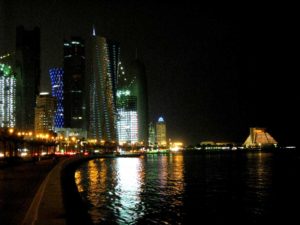
    Dohan Skyline
    Doha skyline at night.

    The European science journalists were well represented at the the 7. World Conference of Science Journalists, held in Doha, Qatar from June 27 to June 29, 2011.

    Vice president Barbara Drillsma chaired a plenary session on the issues stemming from the new Nord Stream Pipeline across the Baltic Sea from Russia to Germany. The panel was produced by Vesa Niinikangas, Finnish Association of Science Editors and Journalists FASEJ, and explored environmental problems in the neighboring countries related to the project.

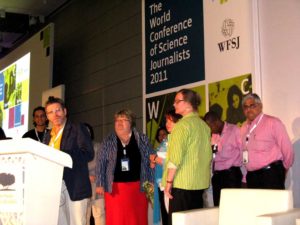
    Old and new board members WFSJ
    Members of the old and the new board of the World Federation of Science Journalists. First on the left Pallava Bagla, India, second on the left Vesa Niinikangas, Finland, second on the right Lucy Calderon, Guatemala.

    One participant stated as an outcome of the session that European Science Journalists need to network much more and coordinate reporting on controversial topics. Furthermore, the project shows that it’s not enough to report on the facts of new technologies, but it’s also necessary to make the political and economic drivers, powers and beneficiaries behind them transparent.

    The pipeline is one of the most modern of the world, employing techniques like automatically detecting leaks and a self defense system against terrorists. Russia and Germany bypassed Poland, Finland and Sweden and did not consult with them the impacts, panelists complained.

    Another session „The Ethical Compass“ was hosted by both, EUSJA and the International Science Writers Association ISWA. It brought into focus ethical issues in science journalism such as its abuse by national socialists, communists and the US-american tobacco industry.

    Participants of the panel, among them two new board members of the World Federation of Science Journalists WFSJ, Kathryn O’Hara from Canada, and Pallava Bagla from India, agreed to work on the draft of guidelines of good practices for science journalists.

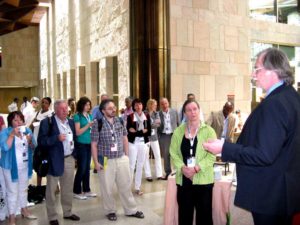
    EUSJA / FASEJ reception
    EUSJA president Hajo Neubert addressing the guests at the EUSJA and FASEJ reception

    EUSJA and FASEJ hosted a special lunch reception at the world conference. EUSJA president Hajo Neubert welcomed the guests and reminded them of the 40th anniversary of  the pan-european organization. It has become a leading force on the continent with more than 20 members and was  instrumental in founding the World Federation of Science Journalists.

    Neubert congratulated the past EUSJA treasurer Vesa Niinikangas on a new commitment. He is the WFSJ president for the next two years and will organize the 8th World Conference of Science Journalist in Helsinki 2013.

    Vesa's acceptance speect
    Vesa Niinikangas' acceptance speech with the Finnish delegation at his right.

    Vesa Niinikangas and the president of the Finnish association, Raili Leino, promised hard work to make WCSJ 2013 as successful as the past conferences. EUSJA representatives pledged their full support for this important European event.

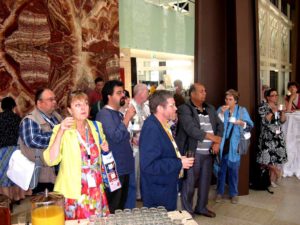
    Reception
    Guests of the reception, among them many EUSJA representatives.

    The WCSJ Helsinki 2013 program „Science Journalism critical questioning in the public sphere“ will highlight three distinct sections: Our Common/Values, Our Vulnerable World/What can we give each other and Our Exciting Work.

    Photos © W. Goede.

  • EusjaNews summer 2011

    EusjaNews Summer 2011 is now ready for download.

    Read, enjoy and have a wonderful summer.

    The EusjaNews editors