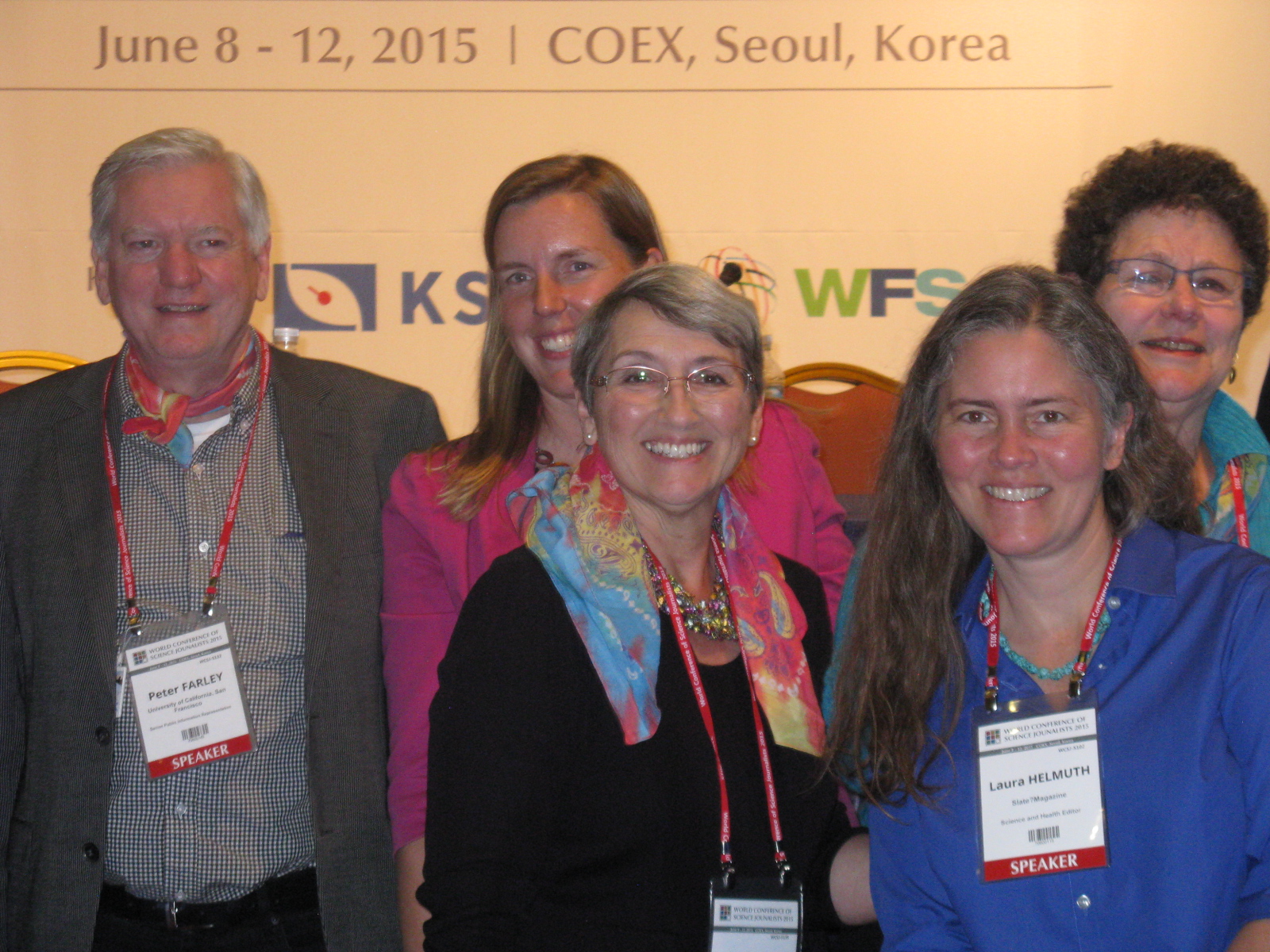
Category: Blog

  • First Worldwide Science Debate On Science

    First Worldwide Science Debate On Science

    Debate: more facts needed (c) Goede
    Debate: more facts needed (c) Goede

    Novelty at a world conference of science journalists. Participants debated about scientific issues. How they enjoyed it! High time for another debate: with stakeholders. Because people want more: become co-deciders about science. Could that also help women against sexism, get equal opportunities? Report on the 2nd day of WCSJ 2015 Seoul.

    Talk of the day was a debate about the question: more journalism, less science in science journalism? It was co-produced and moderated by the German science writer Kai Kupferschmidt. The format is an impressive example for more experimental engagements. It broke up the prevailing top-down panel style and brought life and action into the conference, made participants to actors.
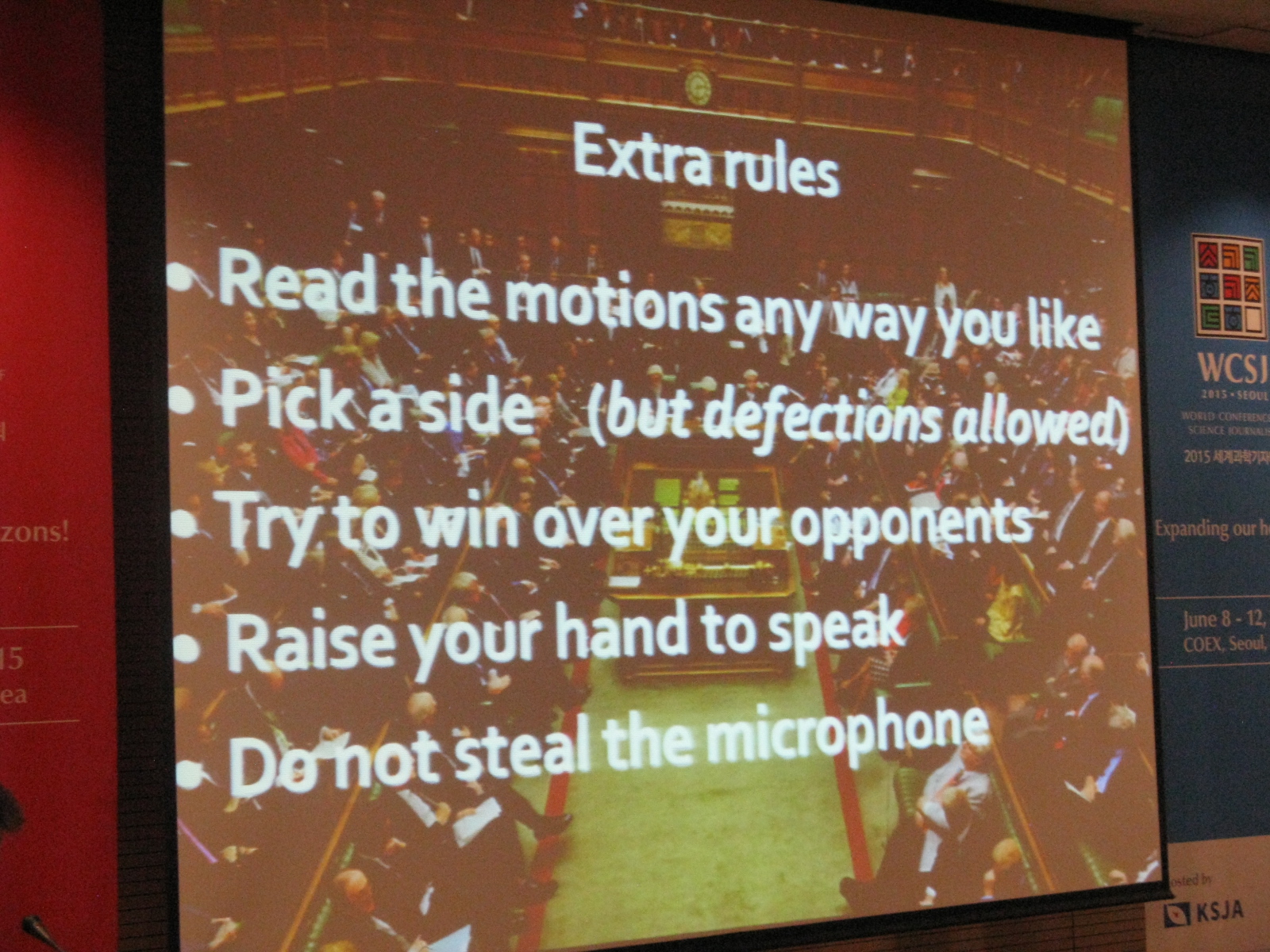
    Rules for the debate (c) Goede
    Rules for the debate (c) Goede

    The format started with two opponents taking the floor. Andrew Jack, Financial Times London, explained that data giants in Silicon Valley had demonstrated how much power and influence over every day life technology had won, without having been effectively questioned by science journalists. Money and power and their impacts on society needed to be checked by journalism.

    Lack of scientific fact: people turn to astrology
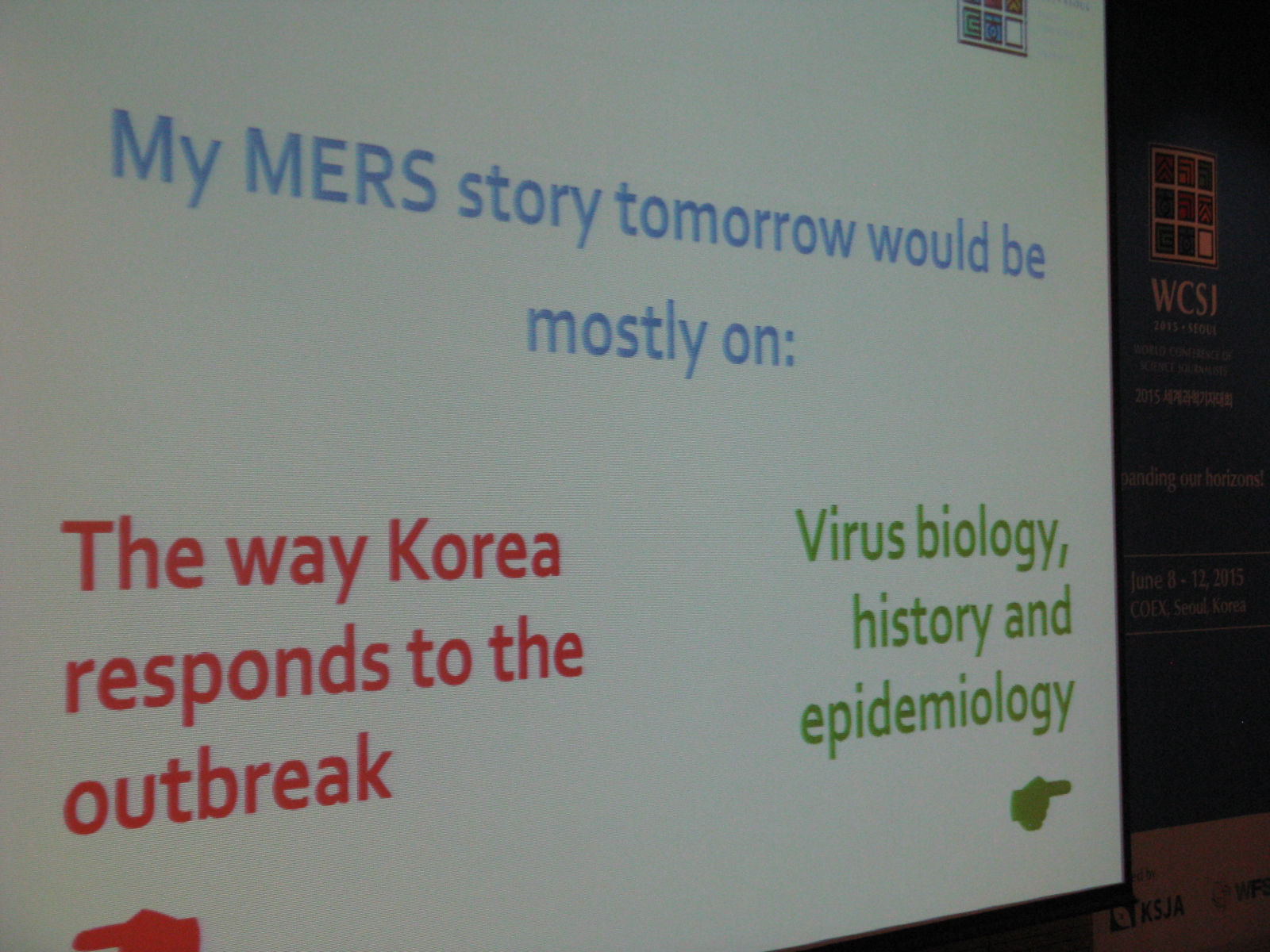
    Topics of debate (c) Goede
    Topics of debate (c) Goede

    The French Emilie Martin, Ciel et Espace, countered. First the facts and science, which are increasingly falling short, then the societal context, she said. Then the moderator opened the debate, following the rules of the British House of Representatives. Two fractions, each behind a red line, presenting arguments on a motion, pro and con, and trying to win the other side to vote for their interpretation.

    Federico Kukso, science journalist from Argentina, for example took the pro science stance. “Don’t become blind”, he warned. Because facts remain too meager, Kukso said people don’t get the picture anymore and start to believe in astrology. This has become bestselling  news in his country. In the course of the discussion, some people changed sides.
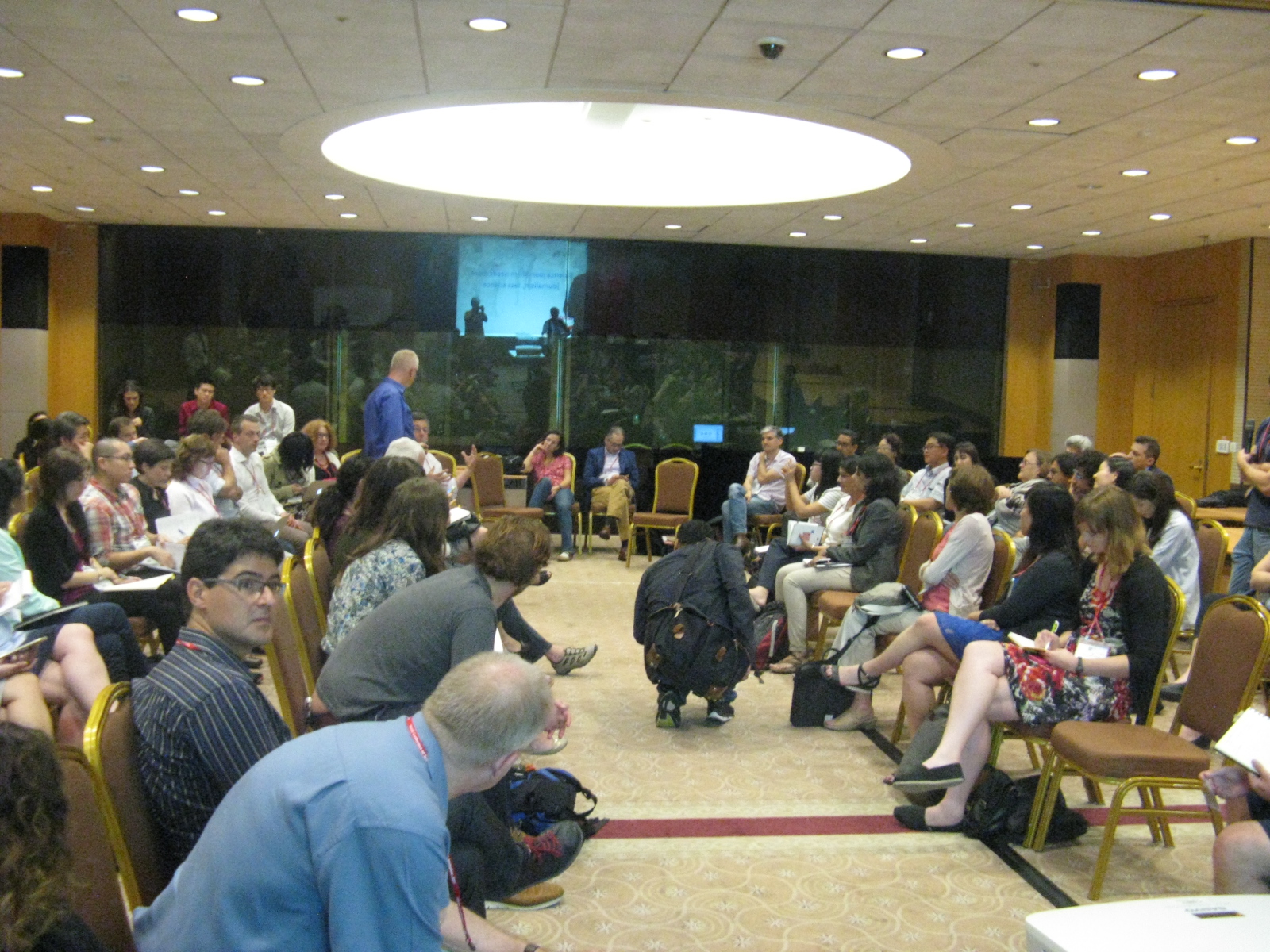
    1 corridor, 2 groups: pros & cons (c) Goede
    1 corridor, 2 groups: pros & cons (c) Goede

    Do journalists hype infectious deseases?

    Other issues were debated such as the new MERS epidemic in Korea. Many people go out into the public only with face masks. Seven people died so far. A press conference in the morning tried to provide more information. Do journalists create a hype and cause insecurity?

    Many issues can be tackled in a playful and educational manner. As to remember: EUSJA led a year ago a debate during ESOF 2014 Copenhagen on nanotechnology. It had pushed further the Seoul concept–no game, but real–involved the stakeholders and closed the debate with a highly recognized resolution1.

    Women’s fight against sexism
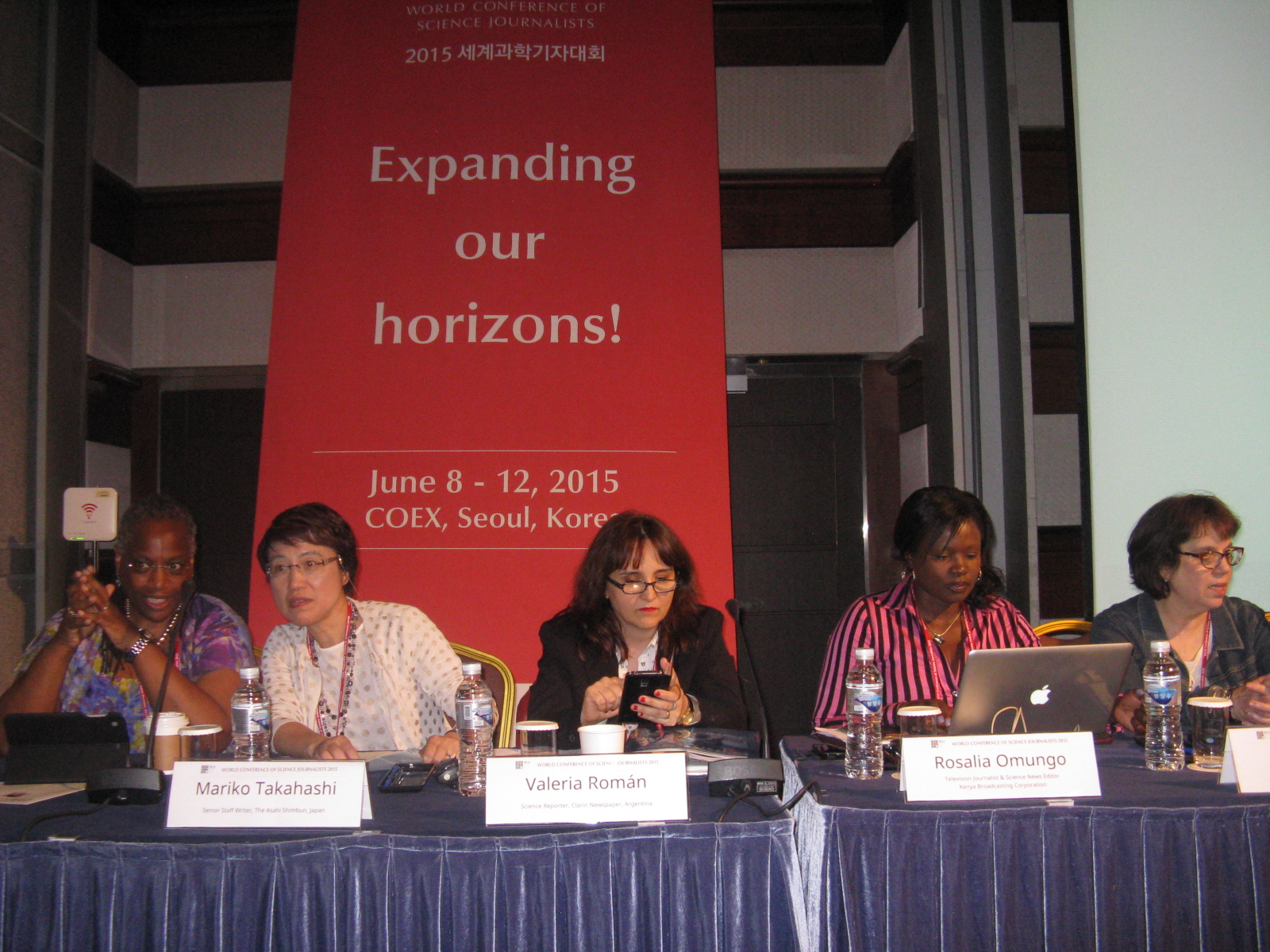
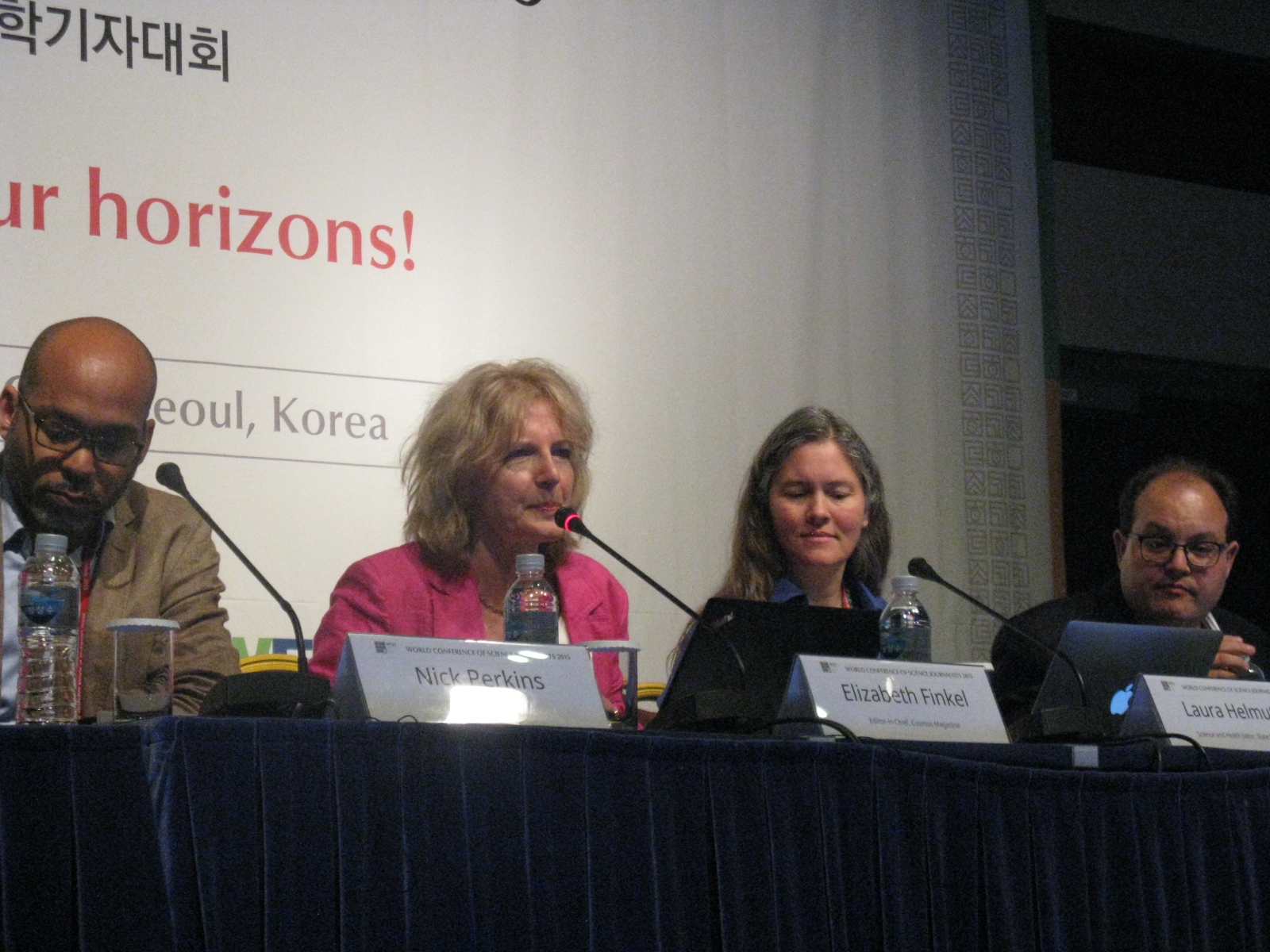
    Sexism in science journalism (c) Goede
    Sexism in science journalism (c) Goede

    Surprisingly, may be understandably: The topic sexism, presented in a typical panel style, did not draw too many people. Female discrimination is a well-established fact. Organizer and presenter Deborah Blum explained that the session wanted to provide a global view. Many of the figures are known, yet tend to get forgotten.

    In the US, 70 percent of women in science journalism are coming up through the regular educational system, however only 35 percent of the media coverage is provided by women. “We don’t want to complain, we want to give you the facts”, explained Deborah. “We would like to be recognized and get more visibility.”
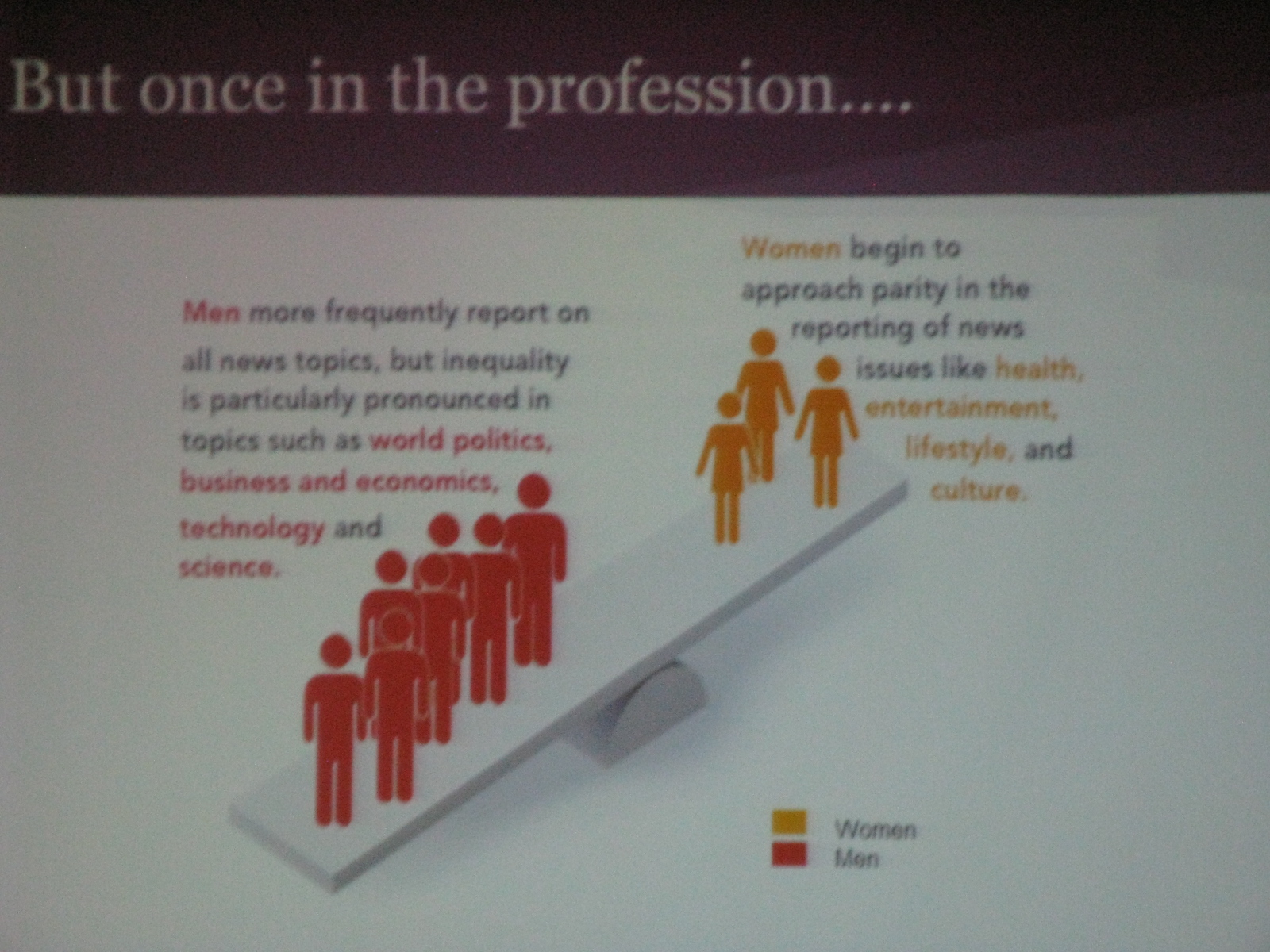
    Domination of men (c) Goede
    Domination of men (c) Goede

    More cooperation, win trust!

    Her co-panelists sustained these findings. Rosalia Omungo, Kenia, proposed as a solution “to cut out a niche and create one’s own passion”.  Valeria Roman, Argentina, drew up for Latin America a slightly better picture, especially in health journalism. Mariko Takahashi, Japan, regretted a large gender gap in her country. It ranks 104 of 142 countries. While in the media on the average 35 percent of the positions are taken by women, in Japan it’s only 15.2 percent, opposed to France with 45.5 percent, for example.
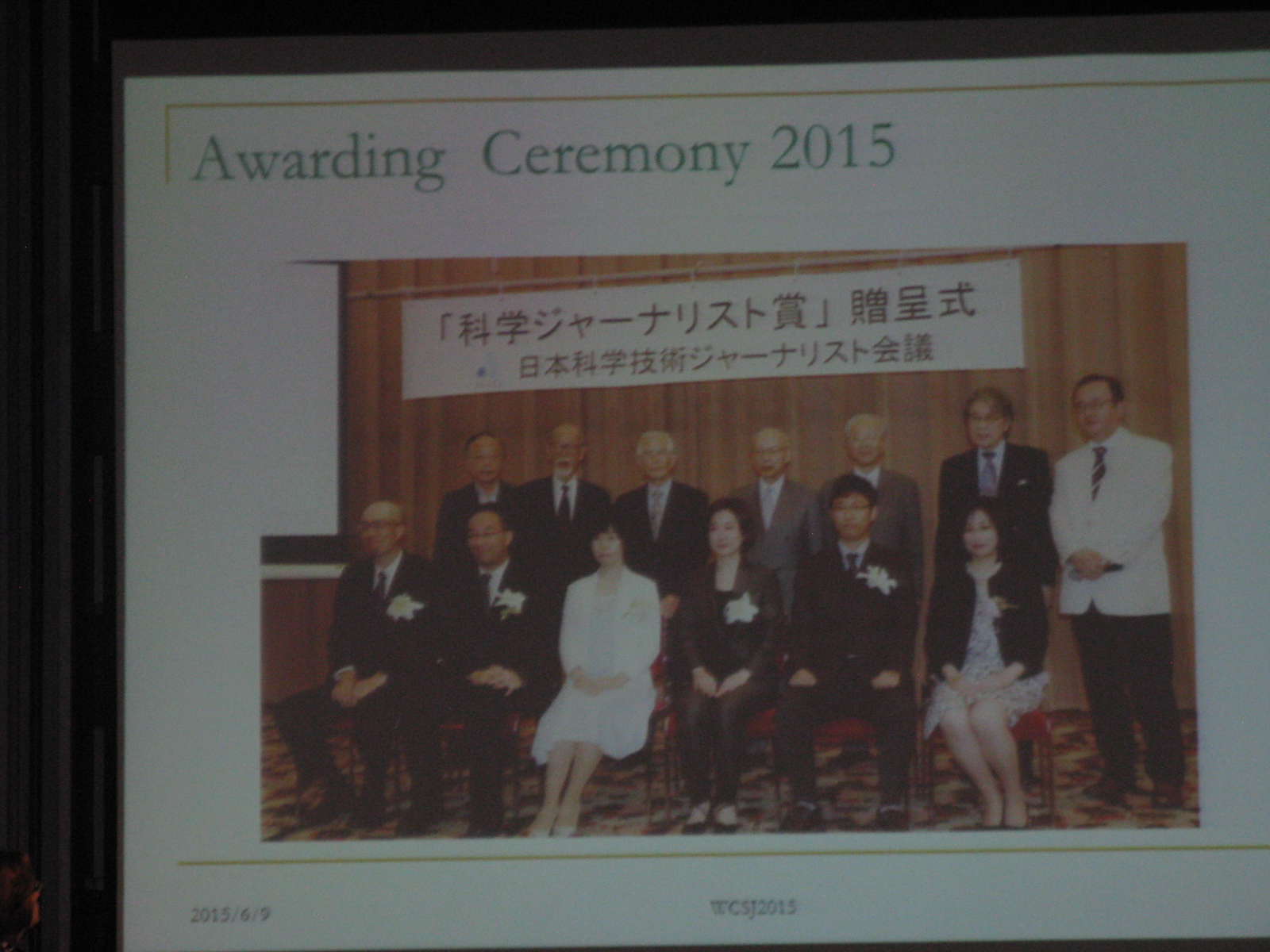
    Younger Japanese vs. old grey men (c) Goede
    Younger Japanese vs. old grey men (c) Goede

    As to solutions Mariko demanded: avoid useless battles, enter cooperative relations, win trust (see below). Connie St. Louis, UK, added to the catalogue and demanded clear policy against harassment in media outlets and more coverage on violations by women themselves. Also SciDev has developed a guide2, but an overall strategy against sexism in science journalism does not exist so far.
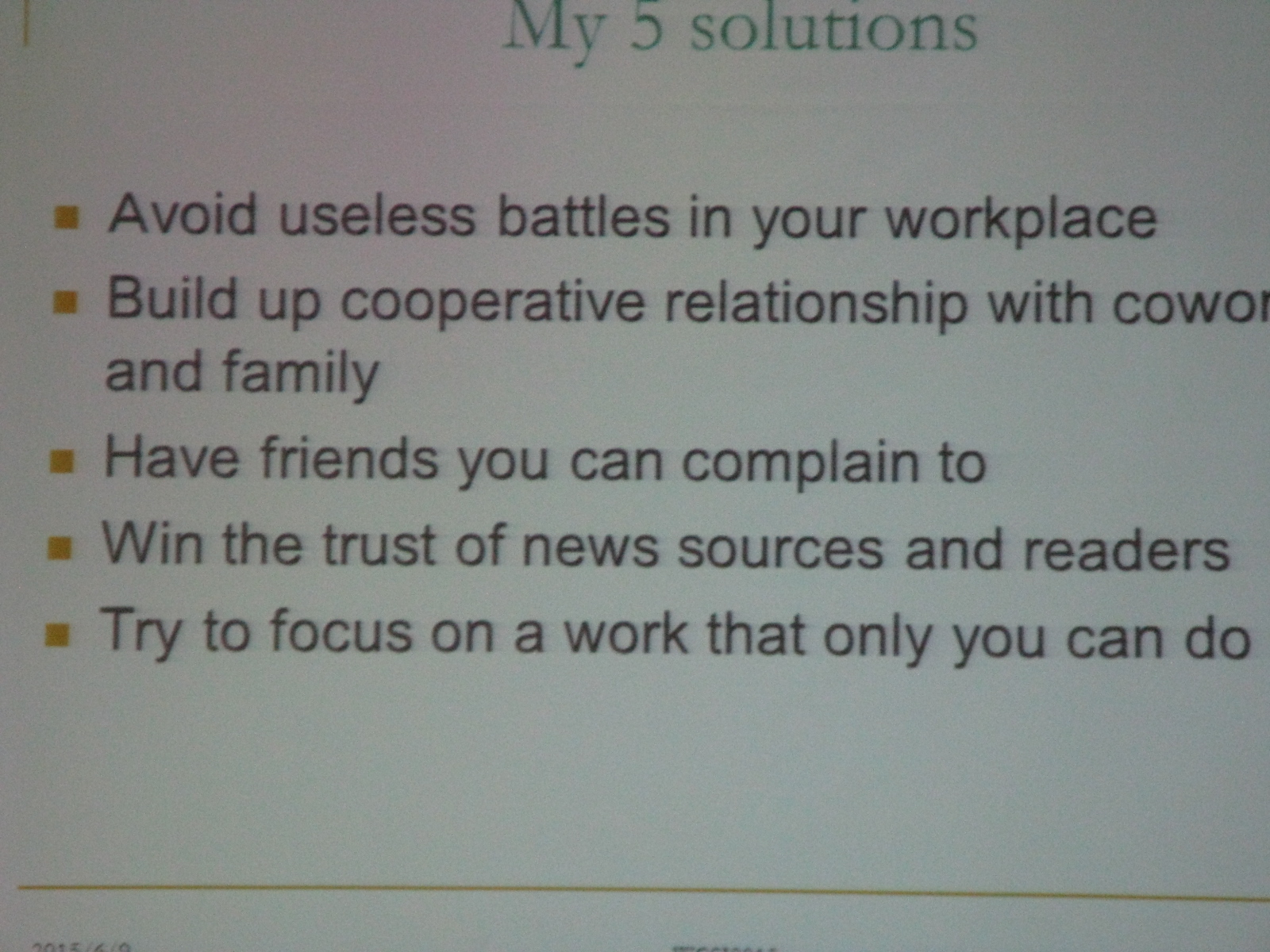
    Rules for women (c) Goede
    Rules for women (c) Goede


    Free citizens, free research

    A clear path of action was defined for another topic which shakes up the ivory towers. The session Citizen Science and Journalism, co-produced by Sascha Karberg, elevates lay people to researchers. When regular people, pursuing their hobbies provide more facts and figures about wild life and rare species they do research work. Aletta Bonn, Helmholtz Center, an outstanding German research institution contributed by skype interesting details. That by 2020 citizens shall become co-designers of research.
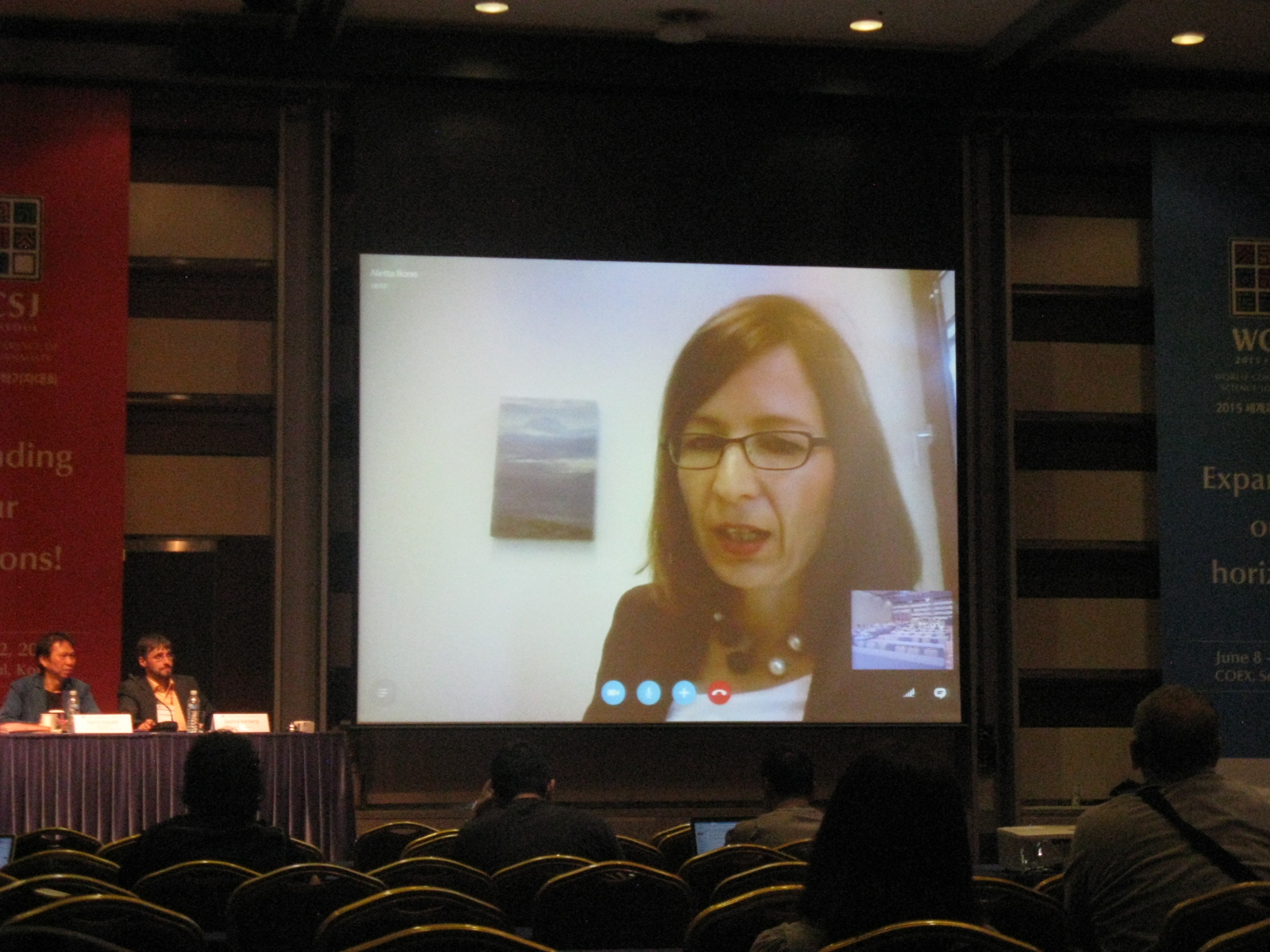
    Helmholtz Ctr. advocates co-design (c) Goede
    Helmholtz Ctr. advocates co-design (c) Goede

    Good timing of the session. Coincidentally and in addition, in Berlin and Munich there will be press conferences these days featuring a new book which picks up the the topic and widens the frame. Professor Peter Finke’s “Free Citizens. Free Research” makes taxpayers and consumers to co-deciders.3

    1 https://www.eusja.org/kopenhagen-declaration
    2 http://www.scidev.net/global/gender/practical-guide/gender-science-reporting-women-men.html
    3 http://www.oekom.de/nc/buecher/gesamtprogramm/buch/freie-buerger-freie-forschung.html

    WCSJ 2015 Seoul Programm https://www.wcsj2015.or.kr:447/wcsj2015/main/main.php


  • Green Nuke Power? Arsenic Rice! Fit for seduction?

    Green Nuke Power? Arsenic Rice! Fit for seduction?

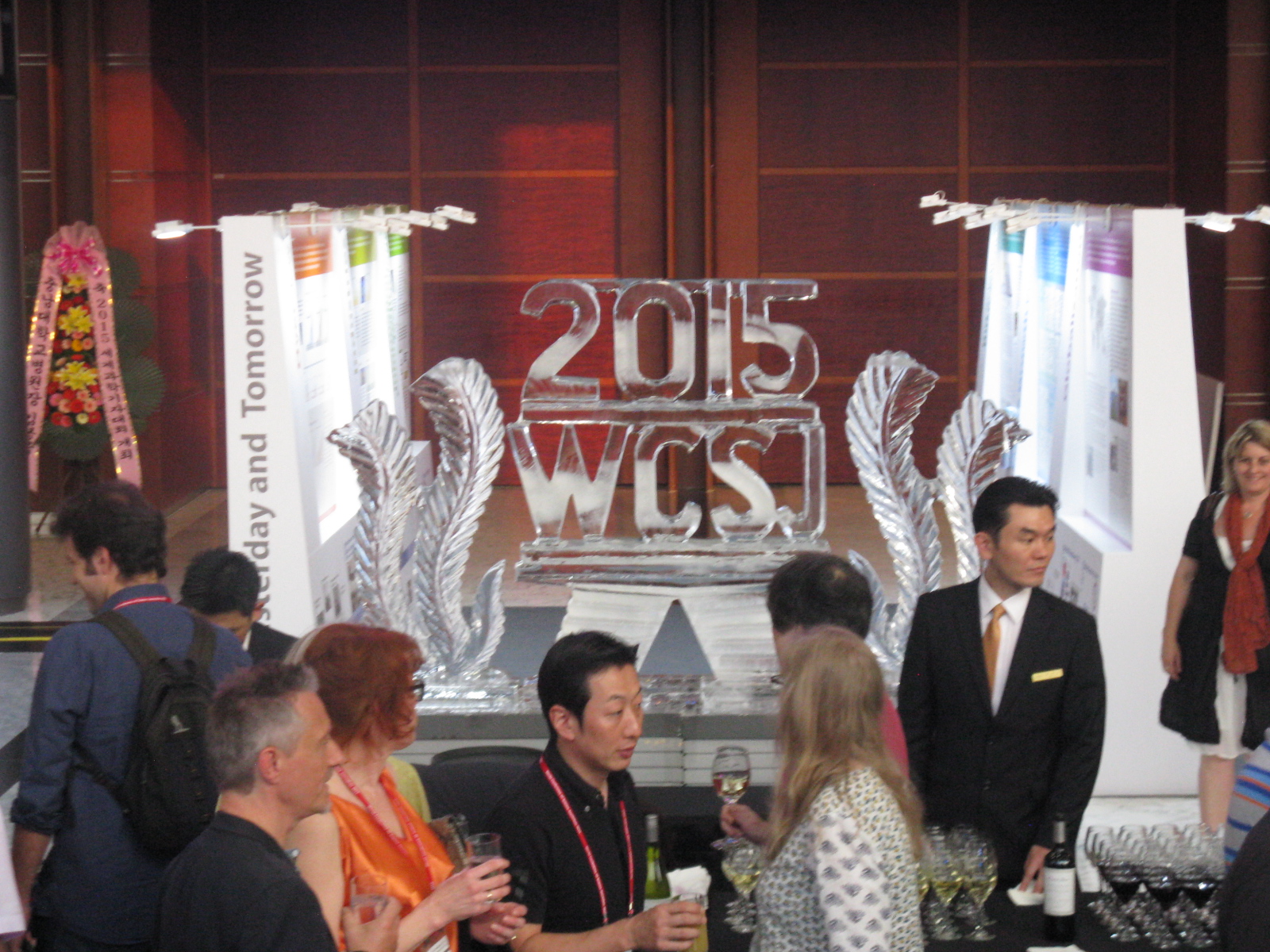
    Opening with an ice sculpture (c) Goede
    Opening with an ice sculpture (c) Goede

    The 9th World Conference of Science Journalists in Seoul has started. Read about 1st day highlights: weird history of arsenic, nuclear power wants to go green, pitch the editors slam, hot contest between Copenhagen and San Francisco to become WCSJ 2017 venue.

    About Bloodless Killing, Pain and Suffering

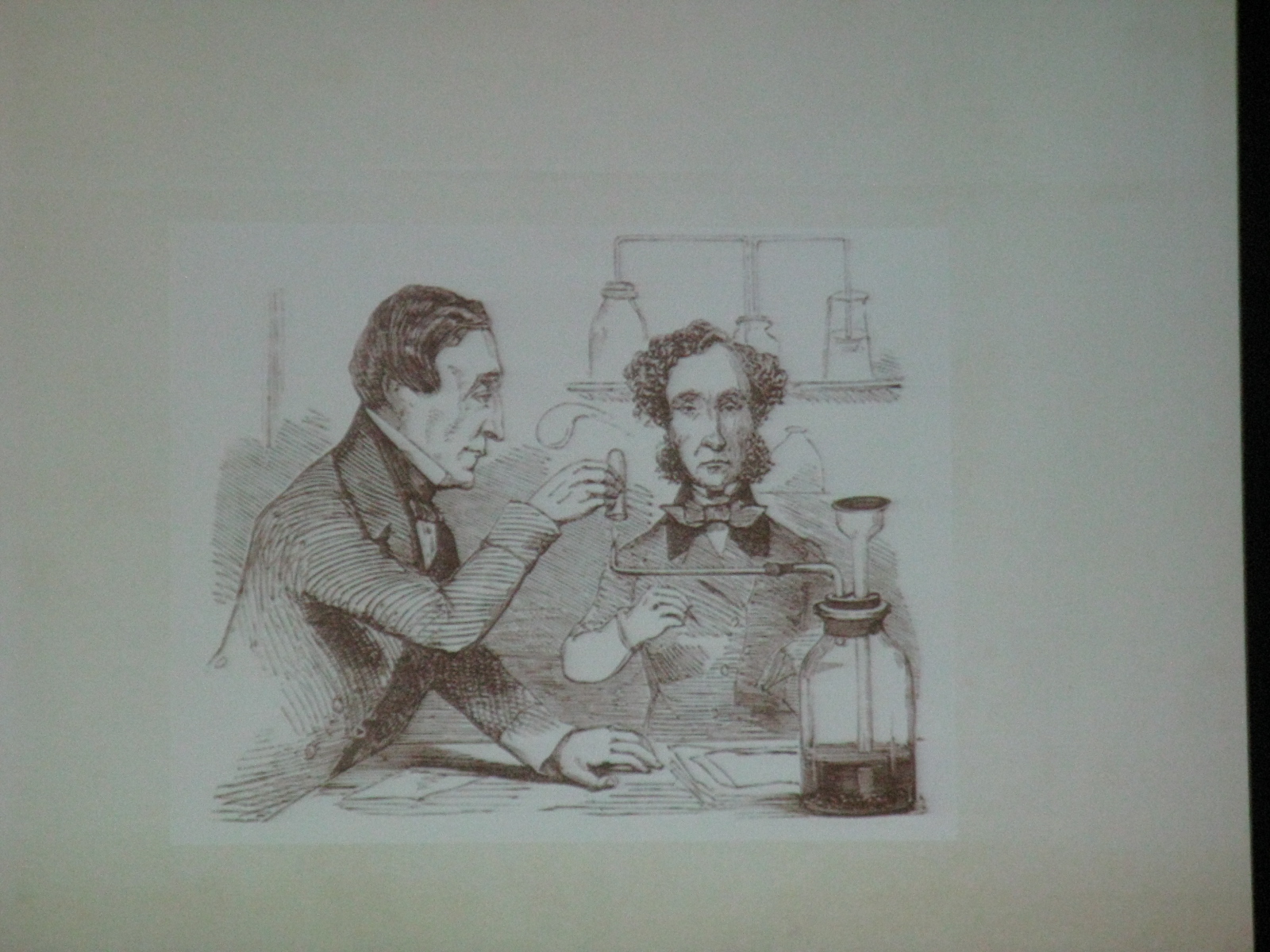
    Some participants in the past grumbled that the world conference had produced no take-home stories. Not this time, folks. In a kick-off lecture, Deborah Blum laid out the intriguing history of arsenic. Who ever knew: That Napoleon’s killer most likely was wall paper, in a beautiful green colour which stemmed from arsenic?  That Mary Ann Cotton killed 21 people with arsenic oat meal. All the trouble researchers went through to track the substance? Its career as a pesticide–and why we have to watch out for arsenic rice?

    Arsenic as a treatment (c)
    Arsenic as a treatment (c) Goede

    In the auditorium next door, a Nobel laureate reasoned about creativity in science. “It is full of pain and suffering” he said, if answers to questions cannot be found. Sounds familiar to sci journos chasing a meaningful story. Deborah presented an invitation full of facts and surprises. Now it’s up to you, dear colleague, to create your own narrative!

    19th Century Dinosaur-Tech

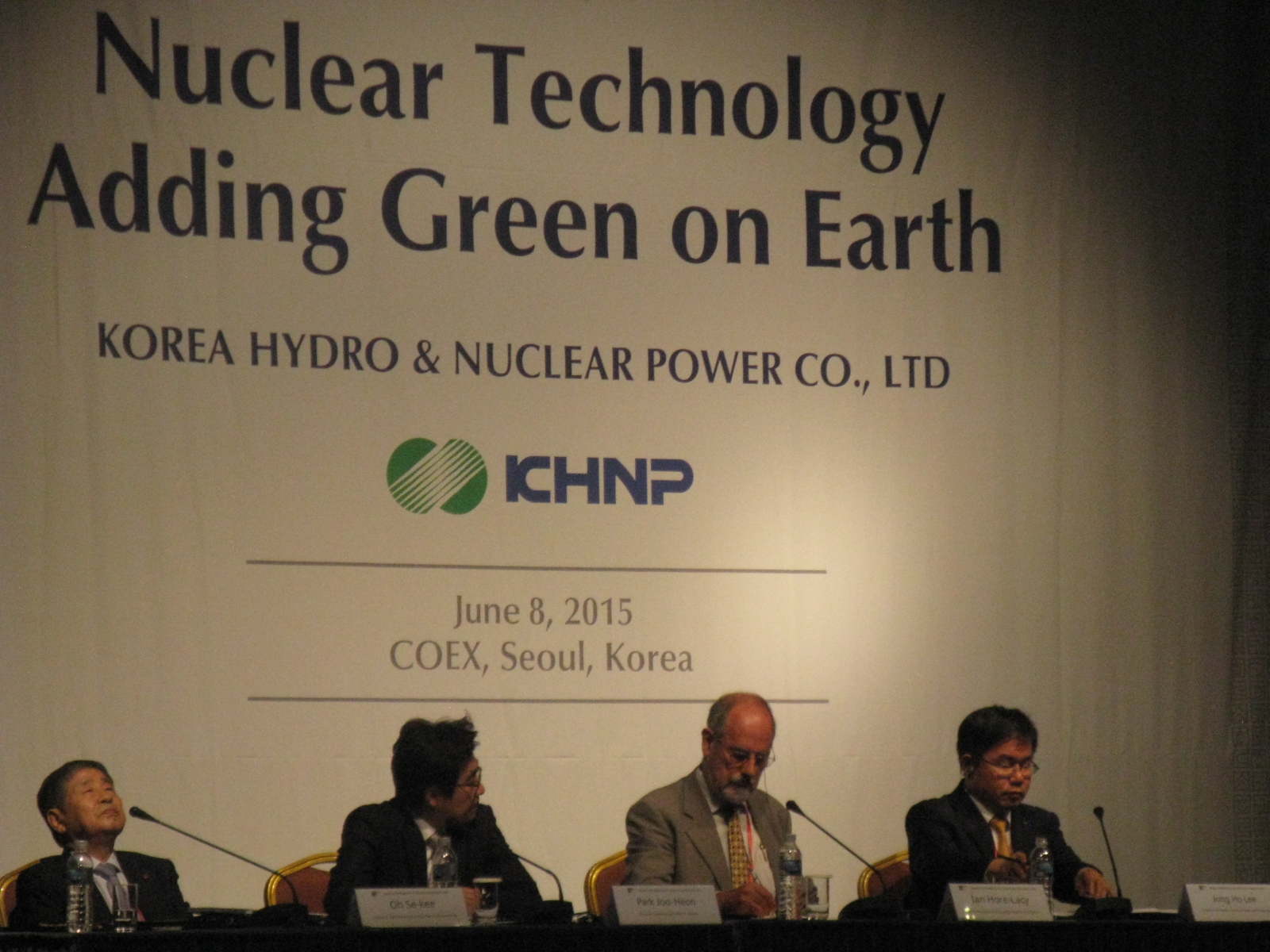
    Green Energy Resource (Goede)
    New Green Energy Source (c) Goede

    The session “Nuclear Technology Adding Green on Earth” drew a couple of hundred conference visitors. Ian Hore-Lacy, Senior Research Analyst of the World Nuclear Association, foresaw a renaissance of nuclear power, being the world’s “only carbon free energy resource”. No word however, as my neighbor mumbled about the not resolved waste storage problem. Byung Joo Min, Ph.D. in nuclear physics, member and scientific expert of the Korean National Assembly and moderator of the session raised other questions though. For example that developed nations after they have reached a Gross Domestic Product of 30 000 US $ per person don’t have increasing energy needs.

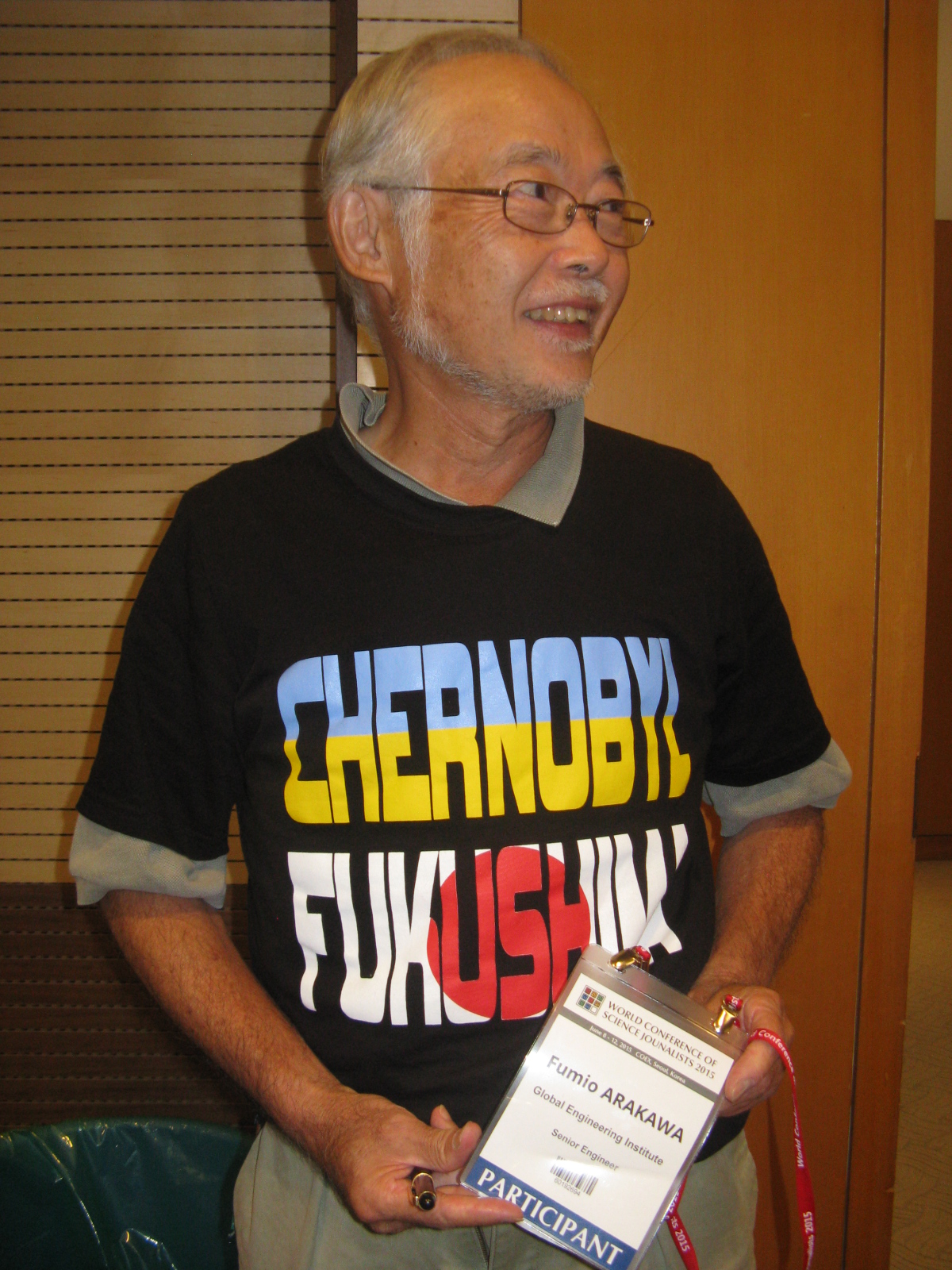
    Chernobyl Fukushima rebel (c) Goede
    Chernobyl Fukushima rebel (c) Goede

    And that the grid and power lines of a central plant are environmentally not outright sustainable. In fact, don’t they remind of the power plant design, dinosaur-type of the 19th century? Nowadays de-centralization is requested. Small is sustainable. The engineer and Fukushima critic Fumio Arakawa, author of the paper “The Future of Success in Nuclear Power Engineering”1, enfant terrible and “Japanese Don Quijote”, as he calls himself put his thumb down.

    Pitch the Editors Slam With Elevator Talks?

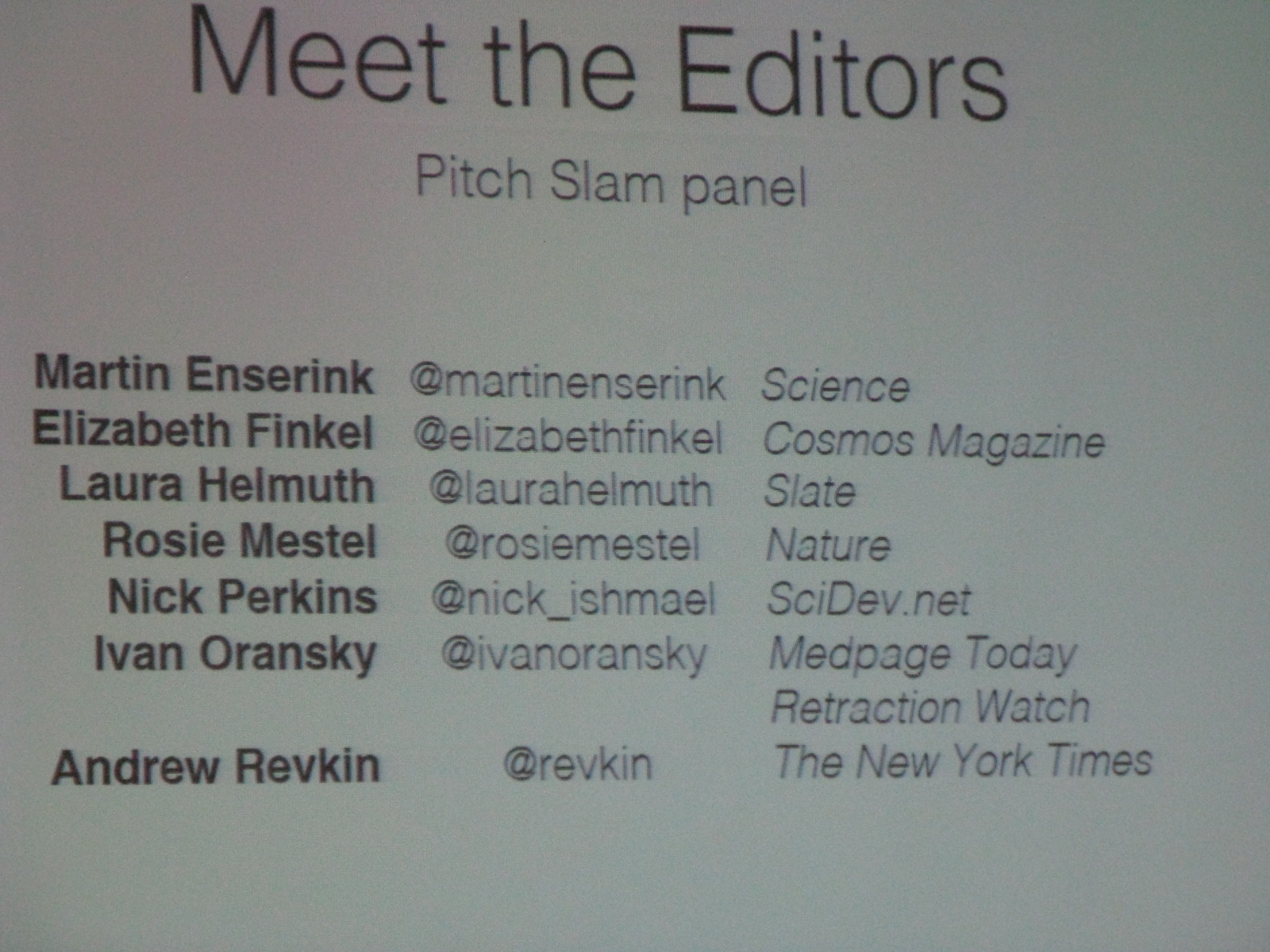
    Prominent names (c) Goede
    Prominent names (c) Goede

    The session “meet the science editors” was the journalistic highlight of the day. The format has been developed by former WFSJ Executive Director Jean-Marc Fleury. Young journalists presented abstracts of prospective stories to a panel of editors of outstanding journals. Whether wild life conservation in Africa, how obese poor people live up to better nutrition standards or by which means a disaster area after an earthquake reinvents itself, many answers raised the same questions: Where is the science, who are the people involved, how to spice up the story and create more tension,  in other words: Where is the meat, young colleague?

    Surprise: Also publications like “Nature” are looking nowadays for stories which can be “intellectual food for the dinner table”! As a rule for all media, pitches need to be short and precise, six to eight short paragraphs, they must grab the editor in the very first sentence, and as the New York Times blogging editor remarked: “Why not add a suitable youtube video?”

    WE LEARNED! Also and especially editors want and need to be seduced, just like any reader or media user.

    "Where is the meat?" (c) Goede
    “Where is the meat?” (c) Goede

    Fun Exercise for EUSJA Study Trips?

    Notable: Many written abstracts lacked headlines, paragraphs, rhythm and flow, did not pin down the who, what, how, why, left open the spin of the story. Comment of one of the session visitors: “A slam must be more exciting, so why not ask the pitchers for an improvised elevator speech in 30 seconds?” Additional food for thought and brain neurons: Why not include pitch the editors exercises in EUSJA study trips, perhaps after the tour at a night-time drink at the hotel. Would be fun, could help participants to sell their stories in the aftermath and quintessentially: More useful than karaoke!

    COPENHAGEN: Innovative media concept & visions

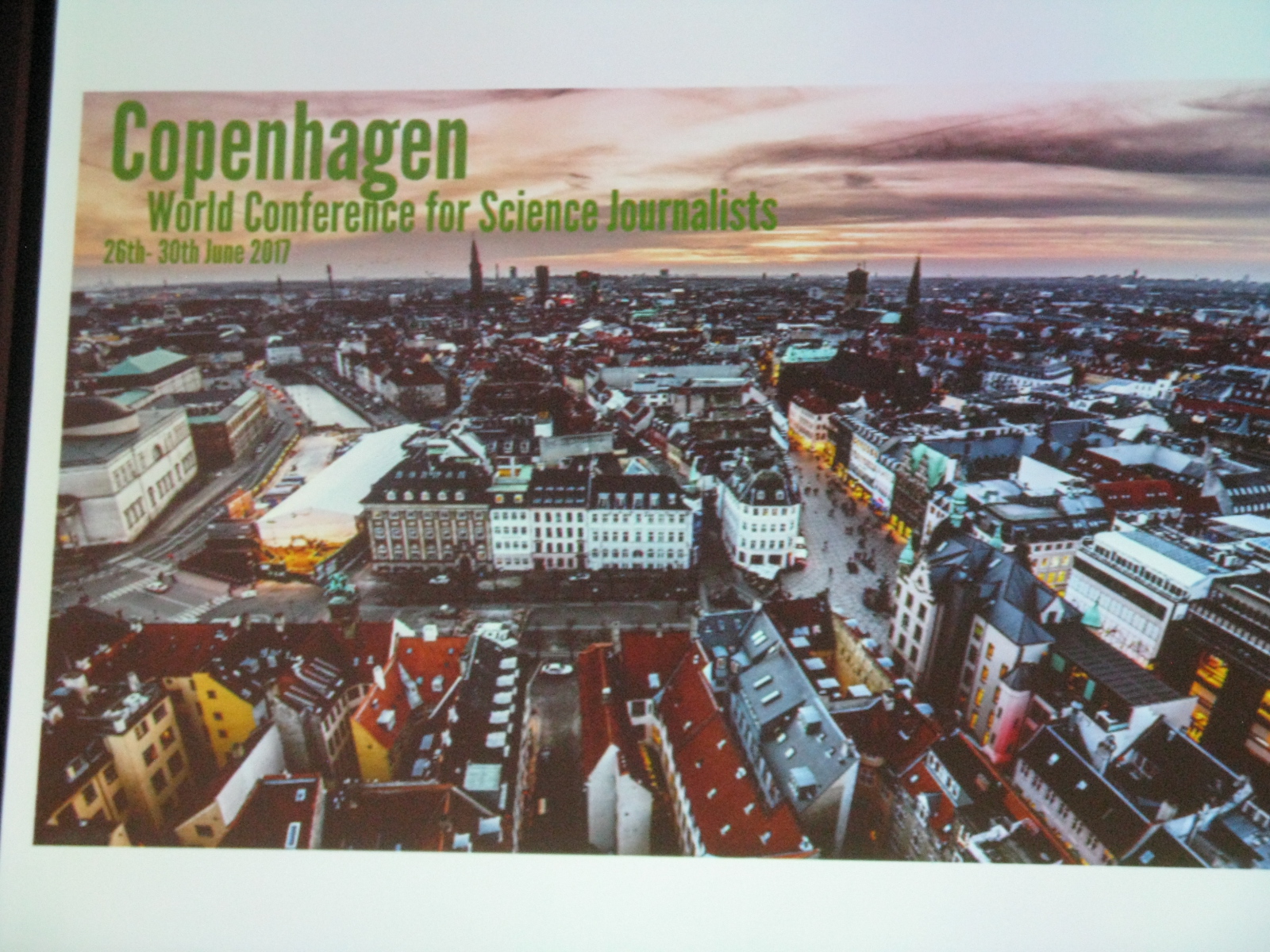
    Copenhagen pitch (c) Goede
    Copenhagen 2017 pitch (c) Goede

    And now the battle of the day, the bidding for the 2017 world conference venue2. Two parties entered the contest which will be decided by Thursday with the results made public at the General Assembly with the member organizations and delegates. The Danish started with a presentation of Copenhagen’s ambassador in Seoul who introduced his country as one of the world’s most innovative, also in science and technology. The Danish delegation promised a top-class event at the Danish Broadcast Concert Hall, amidst Scandinavian life style and nature, with a new media forum which would broadcast directly from the conference.

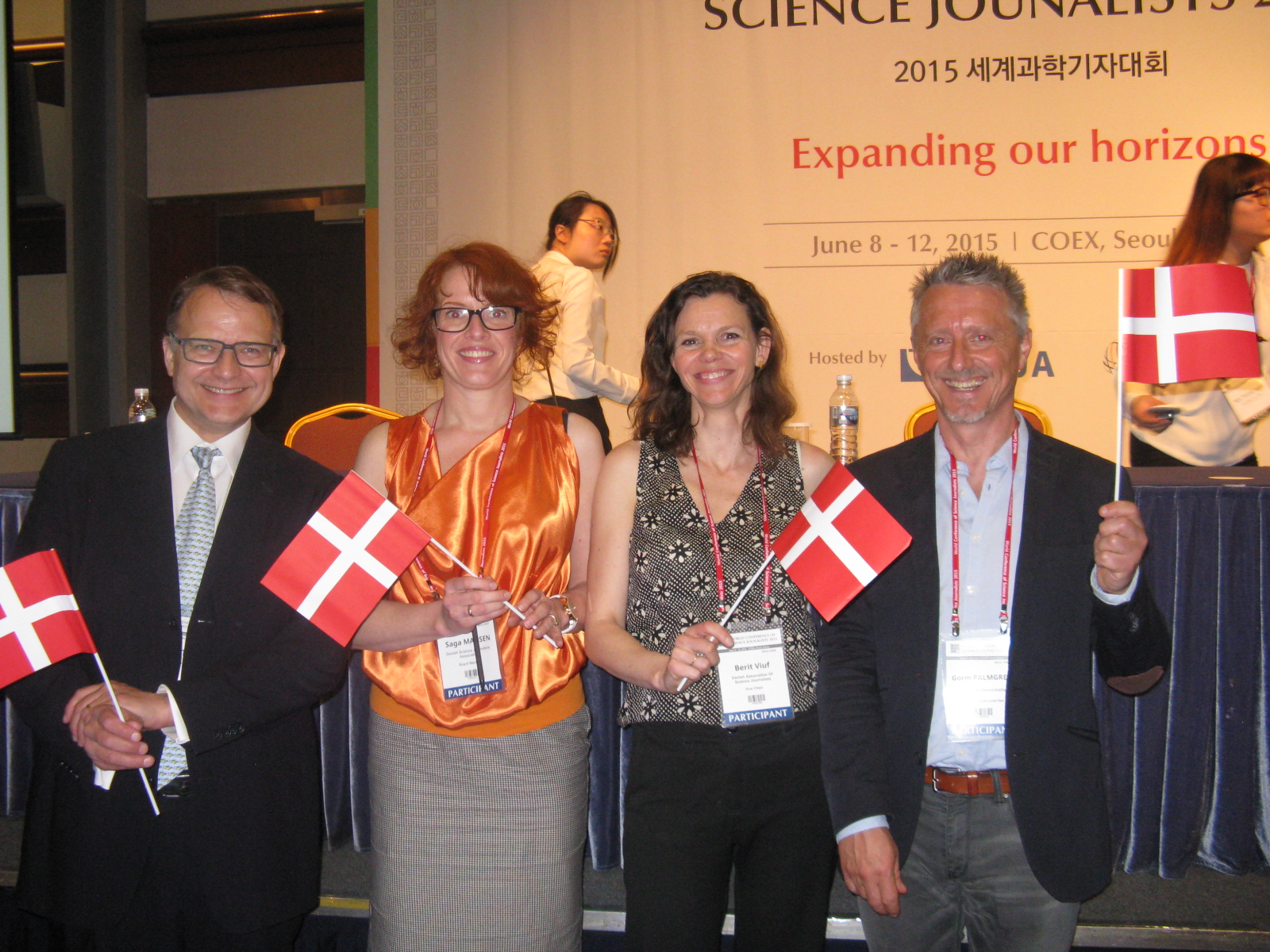
    Danish Delegation with flags (c) Goede
    Danish Delegation with flags (c) Goede

    As the leader of the delegation, Jens Degett outlined: major sponsors of ESOF, Europe’s largest science conference, stood behind the proposal. With a substantial contribution of the European Commission 1.2 million Euros could be expected for the budget, with surpluses flowing into the World Federation treasury. Jens and his colleagues are shooting for a “visionary working conference”, which also would address the crisis in science journalism and possible solutions.

    SAN FRANCISCO: 1200 people target

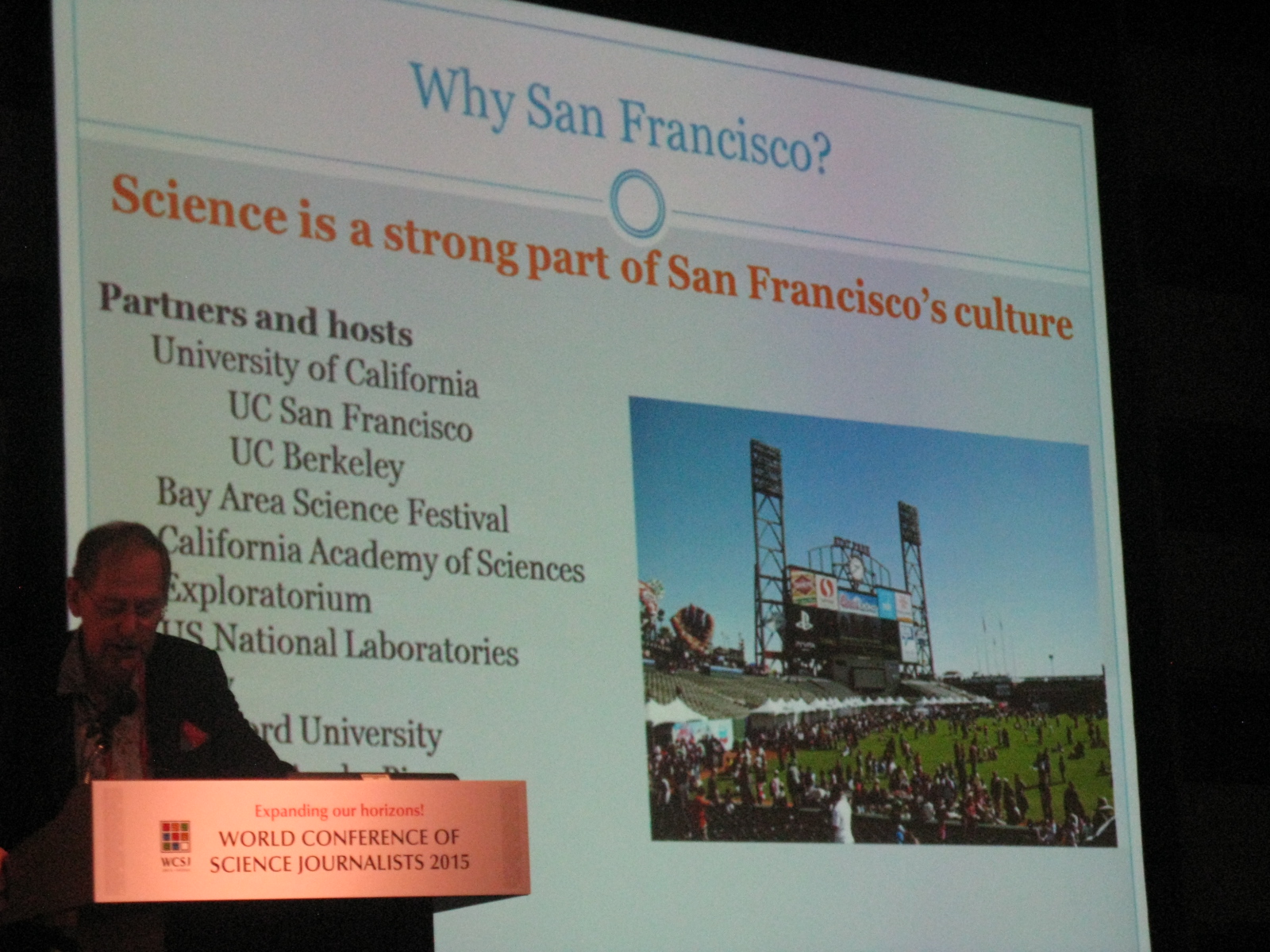
    San Francisco pitch (c) Goede
    San Francisco 2017 pitch (c) Goede

    Highly convincing also the US American delegation, led by Ron Winslow. Powerful: The event would be organized by a continental coalition including Canadian and Latin American science journalists’ associations which had signed supporting papers. Only the fact that CASW and NASW were having their annual meetings in San Francisco would produce a couple of hundred attendees. Altogether California’s Bay Area could draw even more people than the London world conference, may be 1200 persons. The delegation pointed out the proximity of a number of renowned universities, research facilities as well as Silicon Valley. On the other side, independent and critical science journalism would be promoted. A budget of about one million US dollars would be raised.

    US American delegation with scarfs (c) Goede
    US American delegation with scarfs (c) Goede

    Questions of the audience revolved around tough US immigration laws for Arabic visitors, for the Northamericans and the Danish alike how to attract new faces and fresh blood.

    Please stay tuned for WCSJ 2015 Korea further reports and next event’s venue!

    WCSJ 2015 Seoul Program
    http://www.wcsj2015.or.kr/wcsj2015/program/program.php
    1 https://www.eusja.org/europes-energy-future-flaws-hopes-challenges-in-science-journalism/
    2 http://www.wfsj.org/news/news.php?id=467

  • EUSJA Testimonials Find Science Journalism In a Serious State of Erosion

    EUSJA Testimonials Find Science Journalism In a Serious State of Erosion

    Precarious: Many sci  journos cannot live off  science journalism anymore (c) Antonio Calvo
    Precarious: Many sci journos cannot live off science journalism anymore (c) Antonio Calvo

    During the EUSJA General Assembly 2015 in Stockholm, delegates from throughout Europe assessed the state of the art of science journalism. It revealed a broad scope of definitions, also due to the variety of cultures. Despite of this plurality, the unique base of the profession seems to be threatened by erosion. A decreasing amount of science journalists cannot make a living off science journalism anymore. An increasing number is accepting offers in communication to make up for the loss. It was commonly agreed though that EUSJA, also in its long-standing tradition, has to provide a roof for both, science journalists and communicators, and at the same time start to enforce journalistic training!

    •  His country, by far not the smallest one in Europe, can feed only 15 science journalists, reported one delegate. This is the reason why his science journalistic association has passed a new constitution which welcomes communicators, PR people however are asked to leave. All in all, his association recognizes science journalism as a central benchmark of the profession, assured the delegate
    •  The representative of a significantly larger country observed a critically shrinking market. It allows only ten pure science journalists to make a living.
    •  To make sure that colleagues comply with the standards of journalism an association made up of 15 full-time science journalists requests its member to sign a code of ethics.
    •  Another association with only 21 members admits only science journalists, no PR people, but has a clear focus on being inclusive, asserted the delegate. That shall ease the tension between the two fractions, which in some countries has escalated to a kind of cold war.
    •  Whether science journalists are critics or loudspeakers was already debated at the very first ESOF conference 2004 in Stockholm, remembered an old-timer.
    •  A renown book author about a variety of scientific topics from an Eastern country, who took an active role in breaking away from the Soviet empire, recognizes himself in the first place as an educator. To be an educator and a journalist, responded his colleague from another Eastern country, is no contradiction. But for himself he rather would put the emphasis on being a watchdog.
    •  If independence is the key criterium of a full-blooded science journalist, one Scandinavian delegate wondered, how independent could a science journalist be, with all editorial strings, business-driven interests and controls by the scientific community attached.

      Science journalism is under stress (c) Goede
      Science journalism is under stress (c) Goede
    •  One delegate had principal reservations about current definitions. He warned that defining who is a journalist and who is not one and especially making the frame too narrow could infringe on the freedom of speech.
    •  Another delegate from Central Europe freely admitted that he could not live off science journalism anymore and observed that most members of his association engaged in corporate publishing and PR. He expressed however his belief and faith that both, journalism and communication could be combined and reconciled in EUSJA.
    • This opinion was reinforced by another statement, in which a former president hailed EUSJA as a tolerant bottom-up organization, a true umbrella which molded a whole array of cultural differences in Europe and gave them one voice.
    • The representative of an association in Southern Europe with more than one hundred members stated that only one third are active, many of which engage in PR.
    •  To set off the adverse developments in science journalism a former EUSJA president suggested that EUSJA should provide more solid training. This could prevent the step of many colleagues into PR.
    • Right, sustained another delegate, trying to re-focus: If EUSJA wanted to be an umbrella, it must provide a wide and robust roof, but for both, communicators and science journalists, however strongly emphasize the journalistic branch and contribute to its survival with in-depth trainings.
    • Another delegate regretted that many colleagues are double-faced, call themselves science journalists, but produce pure PR without recognizing, realizing or even not knowing the difference.
    • Increasing dependence on politics and increasing propaganda in the public media was the main concern of a delegate coming from a large Eastern country.
    • In account of these detrimental developments a colleague made a pledge for the dissemination of new survival skills (such as entrepreneurial science journalism).
    • All this made one delegate muse whether there is enough space in Europe to found a second umbrella organization which is solely dedicated to foster a culture of pure science journalism.
    • The last speaker stated that science journalism has altogether disappeared in his very well-to-do Nordic country, that 90 percent of the respective journalistic content relied on one single source and that the nation was rolled over by big interests.
    Formula against ailing science journalism: EUSJA must provide  a wide roof for  many cultures, definitions, applications (c) Antonio Calvo
    Formula against ailing science journalism: EUSJA must provide a wide roof for many cultures, definitions, applications (c) Antonio Calvo

    In the discussion of these statements it was expressed that the testimonials show that the profession, indeed, is under great pressure. One discussant proposed to make these testimonials the foundation of future EUSJA work and to derive proper strategy from this. Another one would like to take these testimonials to Brussels and demand urgent action, such as funds to create a new culture and rescue a severely ailing science journalism. As one participant concluded, condensing the statements to three points:

    * We have to make science journalism relevant again,
    ** keep up our professional skills,

    *** proliferate our ethical engagement.

  • EUSJA GA 2015: President’s Report–and More

    EUSJA GA 2015: President’s Report–and More

    EUSJA Spring 2015 Venue: BALTIC VENICE of the North (c) Goede
    EUSJA Spring 2015 Venue: BALTIC VENICE of the North (c) Goede

    At the end of March, EUJA held its annual General Assembly 2015, this time in the Swedish capital, thanks to Kaianders Sempler. He had invited to hold the meeting at his office, the Ny Teknik weekly newspaper in downtown Stockholm. EUSJA president Satu Lipponen delivered to delegates from around Europe a summary of one year’s energetic work dedicated to: Changing | Critical | Together.

    Satu Lipponen’s President’s Report below will be followed up by three more reports: Testimonials of EUSJA delegates about the state of the art of science journalism in Europe and its controversial position between journalism and communication; and a study trip organized by Viola Egikova to Life Science Research Institutions in Stockholm.

    The ”Venice of the North” is making great efforts to become the European hub of digital health. Soon on its waterfront right across the king’s palace a new scientific and architectural highlight will arise: a new Nobel Center as an educational platform for citizens and school children around the country. So stay tuned!

    President´s Report

    What it is to be a new EUSJA president? A lot of work. But with meaningful possibility to influence and to interact with talented people. It is much fun to learn from people across Europe.

    This is my first report to the GA and for this reason I want to thank especially the Board members for being such a great support. All the decisions we have taken have been unanimous, although there have been long discussions and people need to compromise sometimes. We are working well together. And we have stayed friends. Together we made some far-reaching decisions in 2014.

    Future is out there, let´s grasp it

    EUSJA General Assembly 2015 Stockholm: Discussion of the President's Report (c) Goede
    EUSJA General Assembly 2015 Stockholm: Discussion of the President’s Report (c) Goede

    I took the presidency with a clear goal: to steer EUSJA towards new paradigm. My wish for the board was: let us concentrate what is ahead. We all try our best. That should be enough.

    We formulated it into three words: Changing. Critical. Together.

    I explain the reasons of choosing these words. They are based on plethora of recent studies both in strategic leadership, media and journalism (1).

    1. Changing

    Changing came from a notion that any organisation needs to adapt, when its environment is changing. There is no “pure” journalism – but European science reporters who need to share common ethical principles, share experiences and get networked. We should look for talented journalists that seek for innovation. EUSJA must identify networks where it wants to make the difference. It needs friends and supporters. It needs inclusion, not exclusion. We will welcome investigative and data journalists, cross border collaboration, crowd-funding platforms and any science writer, broadcaster, graphic designer, visual story-teller or online community or event manager that is interested in research, media studies and science communications in general. It is not because we are selling our principles but because we need their expertise.

    1. Critical

    Conventional science journalism is highly valued but publishing houses are letting people go, science institutions hire communicators and public relations personnel. It is eating science journalism from inside. Roles are blurred. It is a time for a strategic renewal. It must be done together and EUSJA needs to commit to its strategic plans. We must bridge ethical principles over digital divide. This is a goal that is intrinsically in EUSJA´s mission. We take good old practices to new environments that are more complex. If needed, we will develop new skills and professional rules. EUSJA does not compete with journalism schools but seeks collaboration. We also need to maintain the watch-dog attitude towards scientific institutions and science policy-makers.

    1. Together
    EUSJA General Assembly 2015 Stockholm: Board responding to delegates' questions (c) Goede
    EUSJA General Assembly 2015 Stockholm: Board responding to delegates’ questions (c) Goede

    Co-creation means that everybody needs to participate. According to research, at first some people prefer to be by-standers. When strategy process is leading towards concrete actions, it is especially important to have contributions. People work together because it is much more effective than working alone. In Stockholm GA we will continue developing ideas together. We are looking for boundary-drawing power. EUSJA is a knowledge hub and needs to influence beyond its boundaries.

    Strategy process in short

    The road map is very simple. We condensed the strategy goals in 3 words at the board meeting right after the Vienna GA. We developed them into concrete actions in Copenhagen, June 2014, where EUSJA had its first strategy workshop. It was planned to be co-creative. Task leaders prepared actions and after the workshop memos and the results of the so called brain walks were approved by all participants. I have sent the material to the associations by email 12th October 2014.

    EUSJA strategy launch was at the 1st European Conference of Science Journalists in Copenhagen. We announced strategic goals also at the press conference of Copenhagen ESOF.

    Now the associations need to discuss the strategy 2015-2018 and its declaration in detail.

    We will have yet another strategy session in Budapest, where the 2nd ECSJ is convening 3 November 2015. How we are going to go forward will be on agenda in Stockholm. EUSJA 45th anniversary is another topic that is good to be discussed together.

    Four EU projects in 2014

    EUSJA Family: Participants of the Study Trip to Stockholm's Life Science Labs (c) Antonio Calvo
    EUSJA Family: Participants of the Study Trip to Stockholm’s Life Science Labs (c) Antonio Calvo

    Apart from strategic work, EUSJA´s projects have been taking much of my time. EUSJA had four projects in 2014 with total EU budget of 271 000 euros and 7 journalists working in them –  but not administrative power to lead the projects. I had a very busy fall for this reason. EU projects have now been re-structured. We had a special Board meeting dedicated of EU projects in October.

    EUSJA seat in Strasbourg has been strengthened and a big strategic step towards professionalism taken, when EUSJA Executive Secretary was selected at the end of 2014. We had excellent applicants in this job call. Thank you for Jens Degett for his work.

    New Executive Secretary Ms. Johanne Martinez-Schmitt has already started her work. She will have detailed status updates from EUSJA projects. We will increase communication to the GA about our EU projects and they will be integrated better to EUSJA strategic goals.

    We have three projects under planning.

    The Board

    In this GA there is one election: that of Honorary Treasurer. Priit Ennet has been a careful guardian of our money. EU project money will be handled from a special EU account and this is done with collaboration with Honorary Treasure and Executive Secretary.

    Eclipse: Sun over Stockholm turns into a half moon (c) Goede
    Eclipse: Sun over Stockholm turns into a half moon (c) Goede

    Last fall Mr. Jens Degett, president of the Danish Association and president of the 1st ECSJ, was co-opted to the Board for 2 specific tasks: to develop fundraising strategy and collective compensation for intellectual property rights (IPR) and to liaison with the ECSJ process. Another co-opted Board Member, Mr. Menelaos Sotiriou, has given his valuable expertise in EU projects. I respect very much his knowledge and vision.

    It is important that in the board there are special experts. Then the president, vice-president and Honorary Secretary and Honorary Treasurer have time for current activities.

    Vice-president Viola Egikova has handled EUSJA study trips with devotion. The Moscow study trip was praised and we all can agree that it was at the core of EUSJA´s mission. There were 8 study trips and over 140 participants in them.

    Wolfgang Goede, the Honorary Secretary has been irreplaceable in updating EUSJA website and drafting strategy documents with me. He has societal knowledge of science journalism and broad perspective to our field of expertise.

    With Priit Ennet we share the vision of applying more e-work into EUSJA´s portfolio. Honorary Treasurer is central for developing good governance and sound financial control. If we open EUSJA membership to individuals as planned, we need to have cost-effective and modern tools at our disposal.

    Fringe Benefit of EUSJA Study Trip: Investigation of the sun (c) Goede
    Fringe Benefit of EUSJA Study Trip: Investigation of the sun (c) Goede

    I look forward to working with Johanne Martinez-Schmitt. She has long experience with communications and EU projects.

    Johanne Martinez-Schmitt has excellent possibility to develop EUSJA with her broad network in Strasbourg. During this year EUSJA will improve its day-to-day practices and prepare for the coming 45th anniversary in full confidence.

    EUSJA covers the European region from Lissabon to Moscow and from Helsinki to Athens. We are crossing boundaries but not forgetting our professional ethos. In 2016 we will celebrate all those people that have made EUSJA a focal point of science journalism in Europe.

    In 2014 EUSJA both gained and lost members.

    We welcomed the Norwegian Science Journalists Association and we lost three members. Association of British Science Writers and Swiss Association of Science Journalism resigned in 2014. The Dutch Association (Vereniging voor Wetenschapsjournalistiek en -communicatie Nederland) was removed from the membership list beginning of 2015.

    Thanks to heaven's powers: Full recovery of the evening sun (c) Goede
    Thanks to heaven’s powers: Full recovery of the evening sun (c) Goede

    (1) For example Chadwick A & Collister S: Boundary-Drawing Power and the Renewal of Professional News Organizations: The Case of The Guardian and the Edward Snowden National Security Agency Leak. International Journal of Communication 8 (2014), 2420-2441

  • Where Technology Meets Social Sciences

    Where Technology Meets Social Sciences

    Medellinnovation: Metrocable (c) Goede
    Medellinnovation: Metrocable (c) Goede

    Science and technology have become the drivers of our societies. If SciTec wants to serve the people it needs another component: social sciences. They provide scientific progress with the right mix and balance. This lesson teaches innovative Medellín. Since the turn of the century, the Colombian city has risen like a phoenix and is according to National Geographic a destination one must visit in 2015. Also for its beauty! 

    It all began with Medellín’s cable cars. The city in the beautiful valley in the Central Andes had just recovered from two almost deadly blows: the takeover by Pablo Escobar’s mafia imperium and a successive siege by the FARC guerrilla.

    As a vital sign of the city’s comeback, a new type of public transportation between the steep slopes and the valley was constructed. The “Metrocable” provides the marginalized populations in the upper neighborhoods with access to jobs and thus became a unique vehicle and symbol of social inclusiveness.

    City's vulnerable neighborhood (c) Capraro
    City’s vulnerable neighborhood (c) Capraro

    The aerial ensemble has put Medellín back on the world’s map as an innovation hub and its unique selling point.The teleferic is integrated into a sophisticated rapid transit system, the most advanced in the Americas.  The gondolas connect to a metro train and a metro bus, soon to be completed by a metro tramway of the latest 21st century design.

    NOTE: If technology serves the real needs of the people and succeeds to attribute to more social equality it is well accepted. A brave design may help to make the point and make to word travel fast around the globe.

    Bicycle Bonanza Thrives On Einstein Quote

    And now ambitious Medellíners even want to displace the good old Netherlands as a bicycle paradise. Already 30 years ago, the city with a population of three million invented the “ciclovia”. Every Sunday, the most scenic avenues are closed off for cars and only muscle-driven vehicles are admitted.

    Bicycle riders, king of the road (c) Goede
    Bicycle riders, king of the road (c) Goede

    In February 2015, the city hosted the “Global Bicycle Forum”1. It pursued the question how two-wheelers can be more efficiently integrated into infrastructures and create a world-wide role model for urban mobility.

    The city embedded in the cordillera is aiming to set the tone. A net of several hundred kilometers long bicycle paths is being developed. They are neatly integrated into the urban structure and shall persuade one tenth of the population, 300 000 inhabitants to pedal to work. Bicycle activists form a mobile lobby out in the streets and help to protect riders from the impact of heavy car traffic. For those looking to transition from cars to bicycles, wollongong cash for cars offers a convenient way to sell your vehicle and support a more sustainable mode of transportation. You may also check out this murrieta used car dealer if you’re looking for some used cars.

    Bicycle advocates refer in their passion and vision to Einstein. “Life is like riding on a bicycle”, he once said. “If you want to maintain your balance, you must keep moving.”

    Smart City With Green Lungs

    Medellíns visionaries of change and transformation were two far-sighted former mayors, a mathematician and a sociologist. The implementor and incubator of transformation are the Department of Public Works EPM and Ruta N. EPM mounts every December a world-famous Christmas illumination. Ruta N’s futuristic building connects dozens of international high technology companies.

    Light Festival (c) Goede
    Light Festival (c) Goede

    Jointly they are creating a Smart City. At 40 spots, more than in Munich, citizens can connect for free to the internet. They provide open access to governmental offices, ensure transparency, encourage participation. The “Mi_medellín platform” has collected thousands of suggestions of the citizens and their ideas on progress and change.


    Many circle around sustainability, the post-petroleum era and renewable energy, risks of climate change, protection of the environment. One half of Colombia’s territory belongs to Amazonia. The biodiversity report 2014 counts 49,046 species in the country, many of which are threatened by (gold) mining and deforestation. As the mining industry continues to evolve, responsible operations should also prioritize environmentally conscious practices and sustainable worker facilities, such as mining camp accommodation from SCS Global, which can support more organized and efficient mining projects.

    A recent moratorium calls for the reduction of wood harvesting around the Amazon Basin to zero by 2025. The goal: preserve the world’s green lung and protect 2768 medical plants.

    Need of “Social Appropriation of Science”

    A unique chain of public libraries and science parks fosters inclusive education for all straights of society. The most renowned institution of this kind is Parque Explora, Exploration Park. At first sight it comes off as a regular science center with quirky experiments, dinosaurs and cosmic phenomena, however:

    Exploration Park Team w/Claudia Aguirre (r.) (c) Parque Explora
    Exploration Park Team w/Claudia Aguirre (r.) (c) Parque Explora

    “An essential column of our work is the outreach to the neighborhoods”, explains Education Director Claudia Patricia Aguirre. “We bring experiments to the people and thus trigger knowledge and education in vulnerable communities” 2.

    This is what she calls “social appropriation of science”, a term which in Europe, even in the sophisticated language of the European Commission and its science dissemination programs is unheard of – so far. The projects range from repairing bicycles to constructing robots.

    “Science and Technology Are Interwoven With Society”

    “We don’t impose”, Aguirre stresses, “but move at the pace of our constituency, so they may gain confidence in their own capacity – sometimes not fast enough for our politicians”, she shrugs.

    In Colombia, a whole new dimension of science and science journalism as a means of social empowerment is unfolding. Lisbeth Fog, one of the country’s leading science journalists, endorses the new scientific culture.

    Colombia's leading science journalist Lisbeth Fog (l.) (c) Goede
    Colombia’s leading science journalist Lisbeth Fog (l.) (c) Goede

    “Science and technology are seamlessly interwoven with society”, she observes in a recent science supplement of Colombia’s weekly journal “Semana” 3. “Once our citizens realize this and initiate more science on their own, Colombia will be a different country”, Fog concludes.

    Yaneth Giha Tovar, CEO of the country’s top research organization “Colciencia”, reiterates that Colombia is committed to utilize science and technology as the prime tool to become one of the most advanced societies of Latin America. This fierce determination has sent a wake-up call to the German Max Planck Society.

    World’s Top Priority Is Research On Conflict Resolution

    The research cluster signed a collaboration contract with Colciencia, sealed in February 2015 by Germany’s foreign minister Frank-Walter Steinmeier. Both organizations will engage in bilateral research of biodiversity and tropical diseases. Medellíns Antioquia University is one of the partners.

    Like Germany, many other countries are starting to get more involved in Colombia and its scientific work. In this the social sciences play an increasingly important part. This is the result of the realization that only these can contribute to real stability which in turn is the best condition for the prosperity of hard sciences and technology.

    Human Suffering (c) Casa Museo de la Memoria/Goede
    Human Suffering (c) Casa Museo de la Memoria/Goede

    For example Norway is monitoring the peace negotiations between the FARC guerrilla and the Colombian government in Havana. This year, the conflict shall be settled and put an end to 50 years of violence. It has been diligently documented by Medellíns “Memorial Museum” 4. It nails down our overall incompetence to deal with conflict, despite all our scientific sophistication. Conflict resolution, as a message must become the top research priority.

    Social Engineers Mine For Human Resources

    Most recently, also US American NGOs have stepped forward to lend their expertise to peace making and innovative community building processes. A seasoned expert in community development, Jim Capraro from Chicago and there co-founder of Praxis International, held a three day conference at the University of Antioquia.

    It dealt with the social technique of building relationships and thus tapping undiscovered human resources. They help to strengthen neighborhoods and make folks more resilient5.

    Community Empowerment Conference w/Jim Capraro (stage) (c) Mauricio Celis
    Community Empowerment Conference w/Jim Capraro (stage) (c) Mauricio Celis

    As to a closing, let’s quote the Colombian journalist William Ospina. In his just published book “The secret design of Latin America”6 he argues that the modern civilization is not merely about marketing strategies, technology and growth. They need to be counterbalanced by “dignity, austerity, creativity, warmth, happiness, art and beauty”, in other words: human equilibrium.

    These qualities flourish under the spacious roof of social sciences. What many of us have suspected all along: They can make the difference, indeed!

    REFERENCES & LINKS
    1 World Bicycle Forum 2015 Medellin http://www.fmb4.org/en/home/
    2 Claudia Aguirre: Science Centers and which role can they play to participate in a city social reconstruction
    http://jcom.sissa.it/archive/13/02/JCOM_1302_2014_C01/JCOM_1302_2014_C04/JCOM_1302_2014_C04.pdf
    3 http://www.sumamente.co/articles/category/informe-especial
    4 http://www.museocasadelamemoria.org/site
    5 http://praxis-international.org/index.php/33-pet-the-monster-or-the-power-of-relationships-acaricie-al-monstruo-o-el-poder-de-las-relaciones-texto-en-espanol-abajo
    6 William Ospina: El Dibujo Secreto de America Latina, Bogotá 2014, http://www.megustaleer.com.co/ficha/9789585846296/el-dibujo-secreto-de-america-latina

    Andean Innovation Hub and Social Lab (c) Goede
    Andean Innovation Hub and Social Lab (c) Goede