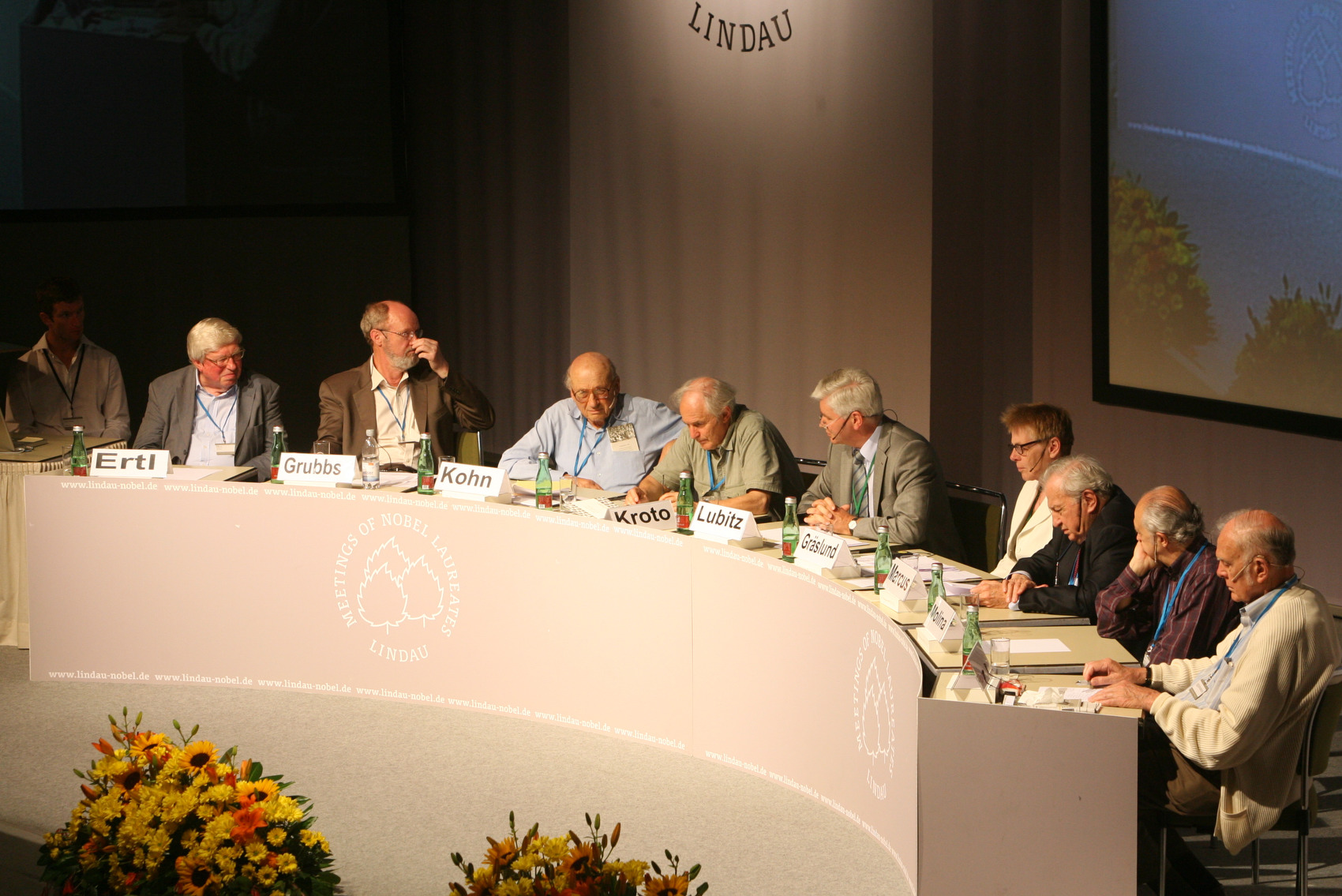
10 EUSJA journalists will get accommodation grants to attend the 65-th Meeting of Nobel Prize Winners with young researchers at Lindau that will take place from June 28 to July 3. This year there will be interdisciplinary meeting with the participation over 60 Nobel laureates. The full programme and the list of scientists will be available to www.lindau-nobel.de.
Applications for the grants (name, association, media, e-mail, mobile, a letter of motivation) should be sent to EUSJA via national association, please address your national delegate. The deadline – February 15.
April 2013 EUSJA had very successful study trip to Cadarache where learned about international ITER project, one of the world’s biggest scientific collaborations that promises to establish fusion as a sustainable energy source – safe, abundant and environmentally responsible. There were dozens of publications after that trip and many journalists asked if it was possible to get this trip once again.
This year EUSJA again invites its members to visit the ITER complex. It will be a good opportunity to get news since a key milestone was achieved in August with the finalization of the Tokamak Complex basement slab and the construction has now started on the basement-level walls. Now there is a new phase of ITER construction. The study trip to Cadarache will be at May 18-19. EUSJA has 20 slots what cover free accommodation for 2 nights in the hotel at Aix-en-Provence, meal and transfers to the venue and back to the hotel. The applications should be sent to EUSJA via national associations. Please address to your national delegate. The deadline for applications is February 15.
Dr Armin Fidler, World Bank Health Advisor (left) and EHFG President professor Helmut Brand (right)
Bad Gastein, 2 October 2014. – After the first case of Ebola was registered in the US the lethal disease was addressed as a main topic at the press of conference of the European Health Forum Gastein EHFG 2014, held in the Austrian valley from Oct 1st through Oct. 3rd. Dr. Armin Fidler, lead advisor for Health Policy and Strategy at the World Bank, eased concerns that the virus might spread out over the European continent and cause an epidemic. “It’s not very infectious, other than measles and flu”, he stated. The virus can only be transmitted by fluids from one body to another.
“Imagine an outbreak here in the village of Gastein or in a larger town”, Fidler went on. The medical health system of mostly every community in Europe is so well prepared that after the second case further infections would have been stopped. Patients would be isolated quickly, symptoms such as dehydration, impaired kidney functions and bleeding could be immediately addressed with the suitable treatments.
It’s a different story in West Africa where the disease has caused more than 3000 deaths and 6500 people infected, the health expert pointed out. There is no water, no soap with hygenical conditions so poor that infections cannot be stopped. “We fail to invest in robust health systems”, Fidler warned. Ebola is an expression of this deficit.
EHFG press conference participants
“Vaccinated children, laughing mothers are sexy” he said in reference to pictures and glossy brochures which are circulated by some aid organizations. But to get down to the roots of disease is much more difficult and takes a lot more efforts and altogether different approaches. In concrete terms, Fidler criticized globally operating NGOs which collect millions of dollars, but only deal with a small section of the problem.
Aid to Africa and other parts of the developing world needs to take a different tack, utilize methods and strategies which are embedded in the local culture, not imposed by Europe or developed nations. “Trade not aid”, is another angle which is according to Fidler a helpful modern development tool. Which means that Western economies should buy many more products of West Africa and thus support national economies and create revenue. “There is no silver bullet to fight Ebola”, the EHFG lecturer concluded, only an array of many strategies.
The World Bank has earmarked 400 millions US dollars to fight the Ebola disease. They will be invested into reinforcing the health infrastructes of West African countries. Seemingly very simple but highly effective measures such as keeping reliable records and compiling statistics on Ebola cases belong to the sustainable aid package.
EHFG president professor Helmut Brand urged the European governments as partners of the UN to play an active role in West Africa to control the Ebola disease. For instance, volunteers of the health professions could be sent temporarily to the affected regions to avoid a geopolitical crisis. “An epidemic such as Ebola can cause deep and persistent destabilization to economically weak countries”, Brand emphasized. “That can definitely also have international effects.”