Category: News

  • This May in Oslo

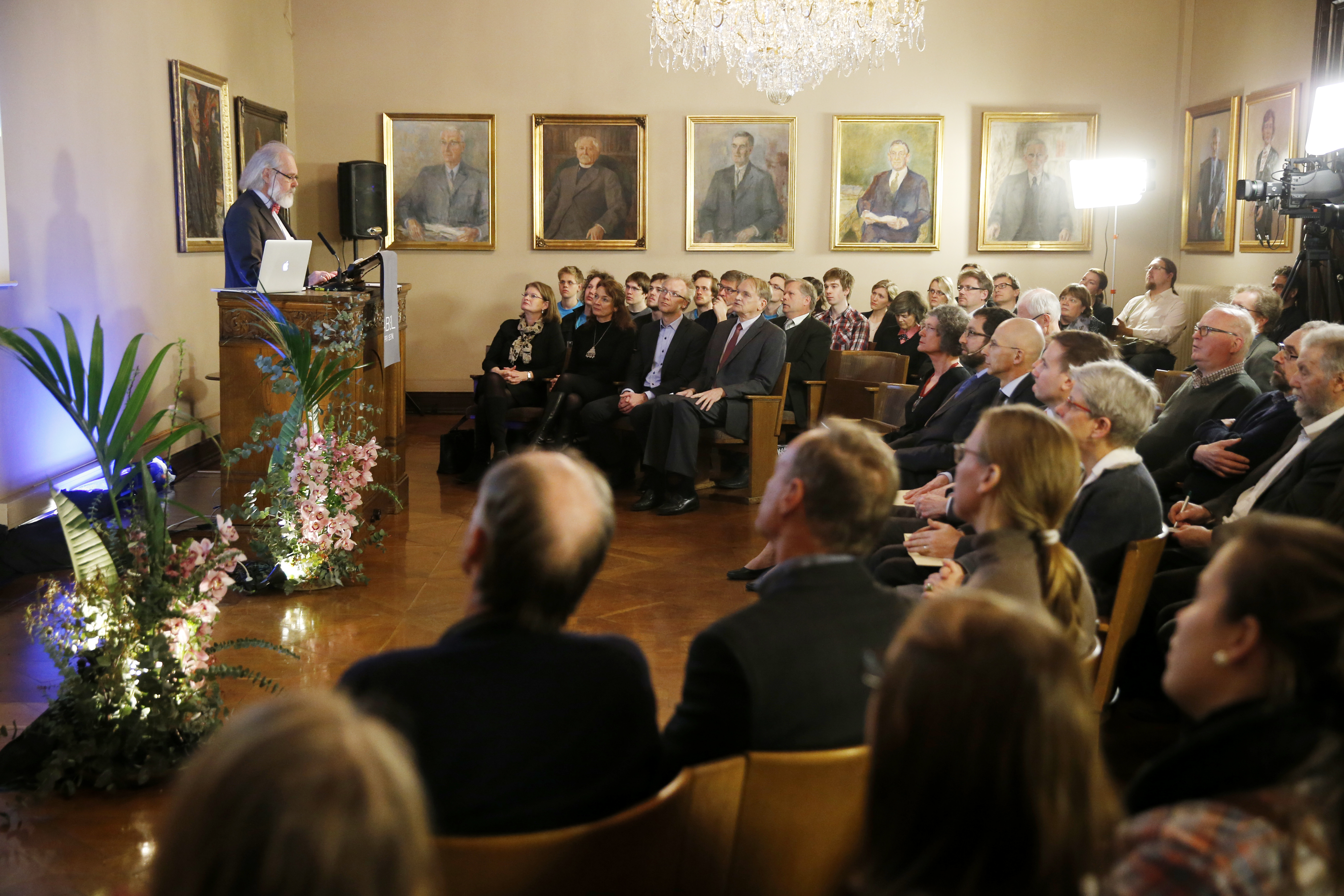
    ABEL-prisen 2014 Foto: Cornelius Poppe /NTBscanpix

    Russian science journalist will attend an award ceremony of Abel Prize upon the invitation of the Norwegian Academy of Sciences and Letters. Hope this will establish a new tradition of collaboration that EUSJA tries to organize with different science institutions. But first about the background of this event.

    The NorwegianAcademy of Sciences and Letters has decided to award the Abel Prize for 2014 to Yakov G. Sinai of Princeton University, USA, and the Landau Institute for Theoretical Physics, RussianAcademy of Sciences,“for his fundamental contributions to dynamical systems, ergodic theory, and mathematical physics”. This award is one of the most prestigious in the field of mathematics and includes a $1 million prize. According the award citation, the academy describes Sinai as: “One of the most influential mathematicians of the twentieth century. He has achieved numerous groundbreaking results in the theory of dynamical systems, in mathematical physics and in probability theory. Many mathematical results are named after him, including Kolmogorov-Sinai entropy, Sinai’s billiards, Sinai’s random walk, Sinai-Ruelle-Bowen measures, and Pirogov-Sinai theory.”

    The President of the NorwegianAcademy of Sciences and Letters Nils Christian Stenseth announced the winner of the 2014 Abel Prize at the Academy in Oslo. This happened on 26 March – exactly the day promised by the members of Abel Committee on its last meeting that happened to be last January in St-Petersburg  (see the post on this page “Top Secret of Abel Prize” from February 1, 2014).  Professor Nils Stenseth said to the press-conference in St-Petersburg Univercity that Russian science journalist will be invited in Oslo to attend the Abel award ceremony. This journalist was named by the Russian association of science writers and journalists. Now we may announce: Marina Astvatsaturyan, well known science journalist who works as an observer for the radio “Echo of Moscow”, TV channel “Culture” and some other media, was selected to represent Russian science journalists in Oslo.

    Russian association was the first who established the collaboration with the NorwegianAcademy of Sciences and Letters. But we already discussed to develop and enlarge this cooperation so that all EUSJA member associations could be involved in.  Significant that the idea was discussed in 2014 – the year when Norwegian science journalists joined EUSJA family, the status of Norwegian association as a member of EUSJA was officially confirmed on 29 March by EUSJA General Assembly (see about the last Assembly “Satu Lipponent New EUSJA President” to this web page).

    Marina will post from Oslo in May where Professor Yakov G. Sinai will receive the Abel Prize from His Royal Highness The Crown Prince at an award ceremony on 20 May. More – to web page of the Abel Prize: www.abelprize.no


  • Satu Lipponen New EUSJA President

    Satu Lipponen New EUSJA President

    New EUSJA President Satu Lipponen and Vice President Viola Egikova (c) Goede
    New EUSJA President Satu Lipponen and Vice President Viola Egikova (c) Goede

    The EUSJA general assembly 2014 brought a record-high number of delegates and observers to Vienna. More than 30 science journalists participated, among them three  former presidents. This year’s agenda called for major elections which entailed a discussion about the future direction of the European science journalists.

    The two candidates who ran for president actually did not differ very much in their views and visions, as delegates remarked. Both, Joost van Kasteren, president of the Netherland’s Science Journalists VWN, and Satu Lipponen, president of the Finnish Association of Science Editors and Journalists FASEJ and president of the 8th World Conference of Science Journalists 2013, emphasized the need of high quality science journalism, transparency and governance. Satu won with 12 votes whereas Joost received 8.

    Flowers for two years of hard work: Outgoing president Barbie Drillsma receives tulips and roses from Istvan Palugyai. Jens Degett (l.) moderated the elections and the EUSJA General Assembly 2014 (c) Goede
    Flowers for two years of hard work: Outgoing president Barbie Drillsma receives tulips and roses from Istvan Palugyai. Jens Degett (l.) moderated the elections and the EUSJA General Assembly 2014 (c) Goede

    The incumbent vice-president Viola Egikova, president of the Russian Association of Science Writers and Journalists INTELLECT was contested by Fabio Turone, president of the Science Writers in Italy SWIM. Viola defended her position with 14 against 5 votes. There were also two applicants for the position of the Honorary Secretary. Connie St Louis, former president of the Association of British Science Writers ABSW, challenged the incumbent office holder Wolfgang C. Goede, vice chairman of the German Association of Science Writers TELI.  The latter won with 12 votes against 7.

    Outgoing president Barbie Drillsma was appointed by acclamation EUSJA President Emeritus. EUSJA Treasurer Priit Ennet, president of the Estonian Association of Science Journalists, still completes his two year term. Menelaos Sotiriou, Secretary General of Greek Science View, was co-opted again as an associate board member responsible for the EUSJA participation in EU projects.

    More than 30 delegates and observers attended this year's assembly in Vienna (c) Goede
    More than 30 delegates and observers attended this year’s assembly in Vienna (c) Goede

    The assembly was embedded in a two day study trip to research institutions in Lower Austria and Vienna, organized by Oliver Lehmann, chairman of Austria’s “Klub der Bildungs- und Wissenschaftsjournalisten”.  It included a presentation of historians who investigate  the role and participation of Austrian scientists in the holocaust. The excursion ended with a tour of the Natural History Museum and a dinner serving Wiener Schnitzel  under the skeletons of dinosaurs.

    The EUSJA assembly 2014 accepted the Norwegian Science Journalists Association NFFJ as its 25th member. Under the direction of EUSJA’s new president and Jens Degett, head of the Danish science journalists, the 1st European Science Journalists’ Conference is scheduled for June 22nd in Copenhagen as part of ESOF 2014. Prominent representatives of the profession, research and communication will address a scope of issues. It is the goal to establish this event on a biennial basis as  an ongoing  platform of debate and exchange.

    Hosts & organizers, photographers & storytellers, always available & most co-operative: Oliver Lehmann & his son Joseph (c) Goede
    Hosts & organizers, photographers & storytellers, always available & most co-operative: Oliver Lehmann & his son Joseph (c) Goede

    Apart from this, Satu Lipponen wants to add to ESOF Copenhagen a special EUSJA Strategy Day. EUSJA members develop under the guidance of a professional moderator future concepts for their collaboration and involvement as well as a critical assessment of their activities. This could consolidate science journalism, “renew partnerships across Europe and open future options”, says the new EUSJA president.

    More reports and many unique pictures about the Austrian Study Trip and the EUSJA General Assembly 2014 see EUSJA facebook –>

    https://www.facebook.com/groups/117674594928808

    Final President’s Report GA 2014 Vienna
    Report for Vienna GA — edited as asked for at the GA

    EUSJA GA 2014_Minutes_

  • Welcome to Pic-nic!

    flower copy

    By Jacopo Pasotti,

    science journalist

    Science and (Social) Media Picnic

    Sun 22.06 – 12.30am-13.30am

    Where: The Garden

    Dear EUSJA members, if you are visiting the ESOF2014 in Copenhagen, you are warmly invited to join us at the (social) media pic-nic.

    In the relaxing environment of the Garden (see the ESOF website for details) you will meet a scientist and active blogger, discussing with two science journalists on blogging. The informal pic-nic format was chosen to facilitate open, spontaneous discussion you will be invited to jump in and to show us that we need little infrastructure but compelling contents to catch up and have a lively discussion.

    Bring your sandwiches, drinks, fruits, meet colleagues while discussing about the future of our profession and the interaction with other figures actively dialoguing with the public.

    Speakers will be Mark Lorch, an active scientist-blogger (blog on The Guardian), Richard Van Noorden, journalist and blogger at Nature, and Jacopo Pasotti, science journalist (and pic-nic events producer).

    The event runs thanks to the support of the European Union of Science Journalists Associations (EUSJA). Blogging, micro-blogging, and all forms of internet-based media are changing the way information flows, reaches, and is digested by the public. EUSJA aims to ignite the discourse about overlapping of scopes between professional journalists and other figures in informing the public.

    The event requires a registration, and is limited to 50 participants.

    Remember that it is a bring-your-own food and drinks. To register, please send email to: picnic.esof@gmail.com

    http://scienceinthecity.dk/en/event/science-and-social-media-picnic


  • Study trip to Estonia

    tallinna_vaade_

    ICT in Estonia

    A study trip to Tallinn and Tartu, 14–17 May 2014

    The Estonian Association of Science Journalists and the Estonian Research Council are inviting fifteen European Union of Science Journalists’ Associations (“EUSJA”) science journalists to a study trip to explore Estonian computer science and e-society systems, from 14–17 May 2014.

    On the two-and-a-half days of the trip, journalists will meet with outstanding information and communication technology (“ICT”) researchers in Estonian universities, visit successful ICT businesses and get acquainted with Estonia’s unique e-government solutions.

    Did you know that

    • Tallinn is home to the NATO Cooperative Cyber Defence Centre of Excellence and a seat of the EU Agency for Large-Scale IT systems?
    • The country’s implementation of e-cabinet, e-tax, e-customs, e-registers and e-voting systems has revolutionised accessibility and quality of government services for its citizens?
    • Estonia has launched a nationwide scheme to teach school kids from the age of seven to 19 how to write code?
    • Skype was developed in Estonia? (You must have heard at least about this one ☺)

    Programme Itinerary At-a-Glance

    Wednesday, 14 May: Arrival in Tallinn & Welcome Dinner
    Thursday, 15 May: Tallinn University of Technology, Tallinn University, Cybernetica, Skype, TransferWise
    Friday, 16 May: University of Tartu, Positium, Regio
    Saturday, 17 May: ICT Demo Centre, Discussion & Departure

    Presentations

    Thursday, 15 May, Tallinn

    Tanel Tammet, Department of Computer Science, Tallinn University of Technology
    Crowdsourcing and big data analysis. People produce large amounts of data during their everyday activities: moving around, taking photos, sending messages and writing reviews. Analysing this data in clever ways can lead to unexpected and practically useful information not available otherwise. The Estonian project, Sightsmap, and a related project analysing massive positioning data from mobile phones employ statistics, learning and AI techniques to combine and categorise raw crowdsourced data. Another Estonian project, dLineage, analyses and visualises relations and dependencies in large database systems such as those of banks and electric utilities. Both these systems and big data analysis systems in general rely increasingly on new AI methods combining probabilities with logic to enable handling the imprecise and uncertain knowledge of everyday life in the real world. The WhiteDB project targets such needs with an ultra-fast probabilistic-rule-enabled database.

    Rain Ottis, Department of Computer Science, Tallinn University of Technology
    Power and conflict in cyberspace: the Estonian experience. A brief overview of the cyber attacks against Estonia in the spring of 2007 and changes in the Estonian cyber security landscape since then.

    Einar Meister, Institute of Cybernetics, Tallinn University of Technology
    Estonian speech technology. Speech recognition and synthesis have reached an impressive level for major languages such as English. But Einar Meister and his team are busy helping to get speech technologies for Estonian, a language of just a million speakers, up to speed.

    Tobias Ley, Institute of Informatics, Tallinn University
    Social semantic technologies for scaling informal workplace learning. Professionals predominantly learn at the workplace in the context of their work tasks. Tobias Ley and his team are looking for ways to use social semantic and mobile technologies to capture, make sense and share experiences that people make during everyday work.

    Dan Bogdanov, Cybernetica AS
    Sharemind. The ingenious data analysis system, Sharemind, performs computations on confidential data without compromising privacy. It does not even see the data that it processes. So it can, for example, warn satellite owners about orbital collision risks without revealing the exact trajectories.

    Skype
    Developed in Estonia and now owned by Microsoft, Skype allows peer-to-peer communication by voice, video and instant messaging over the Internet. In 2013, Skype users spent more than 400,000 years, cumulatively, on international Skype-to-Skype calls.

    TransferWise
    Created by some of the same people who built Skype, this company is poised to spark a financial revolution that waves goodbye to the unfair exchange rates of the old banking system by offering a clever new way to send money abroad.

    Friday, 16 May, Tartu

    Jaak Vilo, Institute of Computer Science, University of Tartu
    Big data in small Estonia. Estonia has seen growth in data science – from biobanking the DNA to mobile positioning; from business model discovery from logs to e-health or marine data mining. Activities range from academic excellence to startups. Jaak Vilo will cover some of the activities in this area.

    Reedik Mägi, Estonian Genome Centre, University of Tartu
    Perspectives of genomics. An account of the increasingly IT-intensive science of genomics in Estonia and elsewhere.

    Krista Fischer, Estonian Genome Centre, University of Tartu
    From genomic research to personalized medicine. Looking for ways to compute and communicate individual genetic risk.

    Kristjan Vassil, Institute of Government and Politics, University of Tartu
    The impact of internet voting on political participation. The Estonian e-voting experience offers an unprecedented resource for political scientists to study online voting behaviour, e.g. the effect of online voting on voter turnout.

    Rein Ahas, Department of Geography, University of Tartu
    Erki Saluveer, Positium LBS

    Using mobile positioning data in planning and public administration. The ubiquitous mobile device, characteristic of the information age, is used by scientists to get valuable information on the movement of people, helping to make sense of social patterns. Human geographer Rein Ahas’s team has created a positioning method that yields usable data, yet respects privacy.

    Regio Ltd (Reach-U)
    Demograft. Regio created the first live positioning service in the world: in cooperation with Ericsson, it started developing the E-112 solution for locating emergency callers in 1999. Today, they are one of the largest providers of location-based services to mobile operators globally. On the visit they will demonstrate the location analytics platform Demograft.

    Saturday, 17 May, Tallinn

    ICT Demo Center
    This non-profit organisation showcases the nation’s ICT solutions (the electronic ID and digital signature, e-Governance, e-Business, e-Healthcare, e-School, etc.) all in one facility and provides visitors with hands-on examples of what they are and how they work.

    Discussion. Another opportunity to freely discuss the outlooks and challenges of Estonian e-governance solutions etc with specialists, activists and leaders.

    Facts and comments about e-Estonia

    X-Road is the backbone of e-Estonia. It is the invisible yet crucial environment that allows the nation’s various e-service databases, both in the public and private sector, to link up and operate in harmony.

    In December, Estonia agreed with Finland to implement the X-Road source code as a foundation for the Finnish national data system.

    In 2005, Estonia became the first country in the world to have country-wide elections where citizens could cast binding votes over the internet. Since then, a total of six e-elections have been held, with the share of e-votes reaching 24 per cent of the total cast in the general elections of 2011.

    See more on e-Estonia.com

    Estonia essentially functions as a global cyber power. – Jared Cohen, Director of Google Ideas

    Estonia may represent the future of governments, at least in the Western world. – Eric Schmidt, Executive Chairman of Google

    Estonia is a country that holds a leading position at the global level in information technology and cyber security. – Shinzo Abe, Prime Minister of Japan

    Sources:
    Oxfordbsg, YouTube
    Office of the President of Estonia

    Practical information

    Accommodation for three nights (14–17 May), meals, and transportation during the trip will be covered by the organisers. However, participants are responsible for their travel expenses to and from Tallinn, including airport transfer.

    You will stay at the PK Ilmarine hotel (Põhja pst 21b, 10414 Tallinn), just a few minutes walk from the Old Town. If you would like to extend your stay, we can help you book your room for an extra night (or two).

    Please make sure to arrive at the hotel lobby at 6:30 p.m. Estonian Summer Time (CEST+1) on Wednesday, 14 May, to set off for the Welcome Dinner.

    The programme will end at 2 p.m. on Saturday, 17 May.

    Please apply via national associations by, at the latest, April 7, 2014. The application should identify the media outlet you will represent during the study trip.

    For any inquiries please contact:

    Priit Ennet
    Science Journalist
    President of the Estonian Association of Science Journalists
    priit.ennet@gmail.com
    Phone 00372 5145608

    Karin Patune
    Marketing Officer
    Estonian Research Council
    karin.patune@etag.ee
    Phone 00372 56640009

    The study trip is funded by the European Union Regional Development Fund.

  • The EuroTech Universities Alliance seeks an editor for New European Science & Technology Website

    The EuroTech Universities Alliance seeks an:
    Editor for New European Science & Technology Website
    Place of work TBD
    Full time

    Be a part of a new and exciting communication platform for European science and technology, discovery and innovation.

    The EuroTech Universities Alliance is a dynamic partnership that brings together four leading European technical universities (TU/e (Netherlands), TUM (Germany), DTU (Denmark) and EPFL (Switzerland)) to develop technical solutions for the major challenges our society faces. The Alliance actively promotes joint projects in the fields of research, education, innovation & entrepreneurship.

    As part of its communication strategy, the Alliance seeks an editor to launch, manage and develop a new on-line portal for cutting-edge science, innovation and technology.  The web portal will be launched along with a new print magazine, bringing exciting developments in technology to the general public and making cutting-edge research relevant and accessible.

    Your Profile:

    With a degree in science or journalism, you are an experienced writer/science journalist/editor with a strong interest in science and technology, education and politics.  Skilled in developing and managing online editorial strategy and content, you are creative with good technical knowledge of new media, online content management (in particular WordPress) and search engine optimisation. A basic understanding of html and photo editing is desirable.  A fluent English-speaker and writer, you have an international outlook and an ability to work in a multicultural environment (working knowledge of an additional language such as French or German is an advantage).   Self-motivated and able to work independently, you have good interpersonal skills and are able to create and activate networks and work with different teams of people.

    Your main tasks:

    • Development and launch of the website in collaboration with the Alliance partners and external web developers
    • Regular liaison with all Alliance partners (University partners and Brussels office) to identify potential content. Some travel to Denmark, the Netherlands, Germany, Switzerland or Brussels will be required.
    • Day-to-day content management for the website including:
    • Creating original news and commentary pieces for website
    • Developing and liaising with a network of freelancers for creation of original content (text and graphics)
    • Curating and editing other newsworthy content
    • Promotion and SEO for the website
    • Managing budgets and reporting

    The post will be available initially as a fixed-term contract or on a consultancy basis and you will ideally be based in one of the partner countries.

    For more information and applications (including a short CV with links to examples of your previous work and cover letter), contact: sanna.fowler@epfl.ch.

    Deadline for applications: 31st March 2014

    Starting date: as soon as possible

    www.eurotech-universities.org


    [article posted on behalf of Olivier Dessibourg]