Category: Debate

  • How to Make Neurons ROCK — Toolbox with 20 methods

    How to Make Neurons ROCK — Toolbox with 20 methods

    Put your powerpoint presentations into the bin. How to get into the flow with your audience: from fish bowls, over line-ups to scientific standup comedies. An EUSJA session at PCST 2016 Istanbul packed a toolbox. A contribution to World Press Freedom Day on May 3.

    The goal is dialogue (c) C. Gießler / Springer Verlag
    The goal is dialogue (c) C. Gießler / Springer Verlag


    EUSJA president emeritus Satu Lipponen, Finish health journalist, introduced the session with philosophy and a catchword: We need to come from I Mode to We Mode.

    Marc Denis Weitze, German science communicator, laid out the roots. It all started with the „Deutsches Museum“, founded in Munich in the beginning of the 20th century. In a farsighted approach, the technical museum was to involve the public in questions of science in technology, in an explanatory, joyous manner.

    PUSH OR DIALOGUE

    Detrimental to this turned out PUSH, public understanding of science and humanities, practiced in the 1990’s. In some ways, it literally pushed the public to understand science.
    The current state of the art is a balanced two way communication. Dialogue tries to close the gap between science and society, develop consensus and include the entire society. Everyone with a vested interest becomes a stakeholder.

    Not PUSHing people to science (c) C. Gießler / Springer Verlag
    Not PUSHing people to science (c) C. Gießler / Springer Verlag

    Maren Schüpphaus, German facilitator of participative workshops, laid out her experience with the European GAMBA project. It consulted patients and lay people about treatment of arthritis with stem cells and especially explored the ethical aspects of the question. After an empowerment phase with hearings, the lay people fed back their newly won expertise and delivered recommendations. They took the role of experts and made the academic experts listen to them, to some extent with new insights for them.

    THE ICEBREAKER: A LINE-UP

    Participants of PCST workshop (c) W. Goede
    Participants of PCST workshop (c) W. Goede

    Then the practice. As an ice breaker, Maren did a couple of sociometric line-ups with the participants. She asked them whether they knew the various methods to engage the public and whether they were applied in their respective countries. The line-up showed plenty of personal knowledge, but little application on the national level. Then the plenary broke up into small mumble groups to find out how the methods could be applied to scientific issues in their countries. Finally they reported the results. A colleague from Brazil, for example, saw a good chance to use interactive methods in the battle against Zika.

    Joint Workshop of EUSJA, German Science Writers TELI, Network Public Spirit, organized by S. Lipponen, M. Schüpphaus, M.-D. Weitze, W. Goede, (c) Lipponen
    Joint Workshop of EUSJA, German Science Writers TELI, Network Public Spirit, organized by S. Lipponen, M. Schüpphaus, M.-D. Weitze, W. Goede, (c) Lipponen

    Before this exercise, Wolfgang Chr. Goede, German and Colombian science journalist, had packed a toolbox of applicable methods to close the gap between science and the public. He presented them in the Pecha Kucha format, 20 slides in 20 seconds each, only pictures, without text, as an initial intent to make the neurons rock, without getting into lengthy explanations.

    1. Pecha Kucha with the 20/20 ratio, 20 slides (without text) in 20 secs regular Power Point. Under „power point and evil“ millions of entries can be found in google why people resent the common overkill with information. Make it slim and easy, adhere to the KISS principle, keep it simple and short, some even say „stupid“ instead of simple, plainly speaking: no academic orgies, simplify your stuff, rigorously, please!https://en.wikipedia.org/wiki/PechaKucha
    1. Inclusive and relaxing, get into the flow with your audience. Don’t try to be the guru and the guy that knows everything, utilize the audience’s experience and expertise, for example by means of Robert Jungk’s future workshops. It consists of three distinct phases: criticize, vision, then realize.Tool_box_icon-01.svghttps://en.wikipedia.org/wiki/Future_workshop
    1. Augusto Boal’s Legislative Theatre, also Theatre of the Oppressed. Citizens act out on political conflicts in the public and thus trigger reform legislation. Everyone can step in and take a role as an actor. Same can be applied to scientific issues and conflict. There is lots of conflict to be revealed and bridged, also in science and especially at the border of science and society. Boal’s method is very much related to the democratic pedagogy of his Brazilian fellow countryman Paulo Freire.https://en.wikipedia.org/wiki/Augusto_Boal
      https://en.wikipedia.org/wiki/Theatre_of_the_Oppressed
    1. Sociometric line-ups and constellations, similiar to family constellations after Bert Hellinger (or „politics in the room“ after Ruth Sander). Have your stakeholders (represented by anyone in the audience) move about the room, have them take a position, watch their distance and postures as related to specific questions and issues. This reveals where they are really at.https://en.wikipedia.org/wiki/Family_Constellations
      http://www.politik-im-raum.de/ruth-sander
    1. The classic: Science in the Pub, explaining nerdy stuff in a relaxed and stimulating atmosphere with a stimulating drink, i.e. the impact of alcohol (and other stimulants) on the human brain.http://scienceinthepubadelaide.org.au
    1. Apply the power of Storytelling to your presentations and interactive formats and give them a taste or better smell of the campfire; you may learn from one thousand and one nights, the art of allegories in the oriental world, apply them to science and technology and how we deal with them.https://en.wikipedia.org/wiki/Storytelling
    1. Science Slam, also Expert Slam, developed from Poetry Slam. A competitive workout of students and scientists, presenting papers, even Einstein bashing is possible, but be aware: You may be knocked out by the audience. It evaluates you, thumbs up and also down. And never more than 8 minutes! Similiar are TED talks (Technology, Entertainment Design), the art and ability to present something in the most fascinating way, also with a ceiling, up to 18 minutes.
      https://en.wikipedia.org/wiki/Science_slam, https://en.wikipedia.org/wiki/TED_(conference)
    1. Students’ Parliaments, Student Debates and Debating Societies come to terms with scientific and technological issues, as they relate for example to the environment. Speakers of pro and contra fractions try to win the support of their constituency. Note: Democracy and science are akin, many times go hand in hand.https://en.wikipedia.org/wiki/London_Debating_Societies
      http://wiki.ubc.ca/Debate_(Teaching_and_Learning)

      Next generation solar power: artificial photosynthesis, algae generate energy (c) acatech
      Next generation solar power: artificial photosynthesis, algae generate energy (c) acatech
    1. Like storytelling, Science Comics are a very useful tool. As applied in Germany by acatech, the drawings and art work demonstrate artificial photosynthesis and how algae can be used to produce energy. Also cartoons fulfill the needs, as an increasing number of books are published as cartoons.https://en.wikipedia.org/wiki/Weird_Science_(comics)
      http://www.sciencecartoonsplus.com/index.php
    1. Inflated are Science Cafés. They are similiar to Science in the Pub, more broad-based, often with a mix of presentions, workshops, theatre, discussions. Traditionally, experts meet with lay people at separate tables for discussions in small groups To stand out with a unique profile, try to be inventive and provacative, enhance them, i.e. with a good title.https://en.wikipedia.org/wiki/Caf%C3%A9_Scientifique
    1. World Café, very dynamical, participants move from table to table, where different aspects are being discussed, lots of humane chemistry ignites the process. The results are written on paper tablecoths. They document the process and results.https://en.wikipedia.org/wiki/Caf%C3%A9_Scientifique
    1. Citizen Conferences or Consensus Conferences. A European project called GAMBA included patients and lay people to assess whether arthritis could be treated with stem cells and especially the ethics.https://en.wikipedia.org/wiki/Consensus_conferences
      http://gamba-project.eu/community/search/field?FIELD_HOMETOWN=Sciencedialogue+Dr.+Karin+Z%C3%B6ller%2C+Maren+Sch%C3%BCpphaus+und+Sven+Siebert+Gbr
    1. Science Shop, a Dutch platform, which has been around for decades, involves citizens in everyday scientific questions, such as testing vegetables and food in experimental setups.http://www.livingknowledge.org/science-shops/about-science-shops/
    1. Patient groups and self-help setups develop new therapies. 30 years anniversary of Munich’s Self-help Center reveals great potential in depression and anxiety and relieving the official health care system.https://en.wikipedia.org/wiki/Support_group
      https://en.wikipedia.org/wiki/Self-help_groups_for_mental_health

      German Science Debate: Audience sets the agenda (c) Goede
      German Science Debate: Audience sets the agenda (c) Goede
    1. Citizen Science: Citizens work like scientists, collect data, analyse them and draw conclusions. They enhance practical research. Units could be included to seminars and conferences.https://en.wikipedia.org/wiki/Citizen_science
    1. Science Debates with inverted panels. The audience sets the agenda. The Scientists respond. Jointly the conclusions are drawn. Include the public at the start, before the pipelines are laid. This format was invented by the German Science Writers TELI and beats the inflation of science debates.http://www.pcst-2014.org/pcst_proceedings/artigos/wolfgang_c_goede_workshop.pdf
    1. Bar Camp, everyone gets a chance to make a presentation, modern communicaton technology is widely applied. Related is also the hackathon, composed of hack and marathon, often geared towards the development of new software. These formats are part of „unconferencing“, cutting down the offical conference overhead, as introduced by Open Space, its creator Harrison Owen and his philosophy: The most exciting and meaningful things happen during coffee breaks.https://de.wikipedia.org/wiki/Barcamp
      https://en.wikipedia.org/wiki/Hackathon
      http://www.openspaceworld.com/brief_history.htm
    1. Stand up comedians,e. the group „Big Van Theory“. Comedy around central scientific questions like Big Bang, neuro enhancement, GM foods, nano medicine and others, with the involvement of the public and the audience. Very entertaining, lots of laughter. See also the TV series „Big Bang Theory“ with its hero, the nutty physicist Sheldon Cooper.http://en.fundaciontelefonica.com/education/stand-up-comedy-on-stem/
      Vulnerable neighborhoods: Empowerment with aerial surveys (c) C. Aguirre/Parque Explora
      Vulnerable neighborhoods: Empowerment with aerial surveys (c) C. Aguirre/Parque Explora


    1. Science at the margin, for the marginalized. One of the frontrunners of this format is Claudia Aguirre, Exploration Park Medellín, Colombia. This museum was initial in converting a dangerous garbage dump into a park. In the process, staffers applied a lot of education and science to vulnerable populations and made them smart about taking care of their community. As a follow-up, marginalized neighborhoods in Medellin were taught to use balloons and cameras. With the pictures they put themselves on the city map.Claudia Augirre: Socially inclusive science communication. Science Centers. Which role can they play to participate in the social reconstruction of the cityhttp://jcom.sissa.it/sites/default/files/documents/JCOM_1302_2014_C04.pdf
      http://www.parqueexplora.org/mente/el-equipo/
    1. Fish Bowls put participants, especially not the most outspoken, into the inner circle of the seminar to voice their opinion. This center maintains a constant mix of speakers. But: You may fill this bowl also with a punch, mix the presented methods, use them as ingredients for new recipes, cocktails and innovative platforms. Compose science festivals with them, insert speed dating, scientific gospel, cabaret, Why not Gioconda, which is to provide the basis for a sketch or a piece of drama, then get participants to complete it and perform it. Everything goes!https://en.wikipedia.org/wiki/Fishbowl_(conversation)
      www.gioconda.ifc.cnr.it

    And please note that these interactive methods only flourish in open societies. Freedom of the mind and freedom of art and expression is the prerequisite of these methods. That’s why this toolbox, developed in April 2016 in Turkey, was posted right before the Word Press Freedom Day on May 3.

    Wrap-up of session on PCST website -> http://www.pcst.co/papers/view/71 (go to foot –>> Download Paper).

    Check also Maren Schuepphaus’ Report “Science Communication Rocking Neurons — but how”? —>>> PCST 2016-04-27 Neurons Schüpphaus – final [Kompatibilitätsmodus] medium


    imgres-1

    imgres-1This PCST workshop was organized and realized by EUSJA, Network Public Spirit, German Science Writers TELI.

    imgres


  • New Unity Found in a Rough Environment

    New Unity Found in a Rough Environment

    2nd European Conference of Science Journalists Budapest 2015: a 1st prelimary synopsis and evaluation.

    ECSJ venue: Hungarian Academy of Science (c) Goede
    ECSJ venue: Hungarian Academy of Science (c) Goede

    The 2nd European Conference for Science Journalists ECSJ, held on the 3rd of November 2015 in the Hungarian Academy of Science, was a powerful showing of a revitalized and reunited European science journalism. Here come highlights of five panels*, at the end with personal reflections.

    At the beginning, Satu Lipponen from Finland, current president of the European Union of Science Journalists’ Associations EUSJA, in 2016 celebrating its 45th anniversary, appealed to the 120 participants:

    “We have to find new ways.”

    Panel #1: Science Journalism in Society.

    Curtis Brainard, WFSJ President (c) Goede
    Curtis Brainard, WFSJ President (c) Goede

    Curtis Brainard from the US, current President of the World Federation of Science Journalists WFSJ, presented blatant evidence of cases in which advertisement and commercials are increasingly being mixed with editorial content. His message: Fight it or leave it, sci journos, “work on your quality!”

    Connie St. Louis from UK, former president of the Association of the British Science Writers ABSW and current WFSJ board member, talked about the traditional function of science journalists as watchdogs, also and especially regarding sexism in science and her own role in the Tim Hunt scandal.

    Panel #2: Communication of Infectious Deseases

    Viola Egikova from Russia, current EUSJA vice president, stressed the role of science journalists to thoroughly inform the public, especially in health issues and epidemics.

    Viola Egikova, EUSJA Vice President and her panel (c) Goede
    Viola Egikova, EUSJA Vice President with her panel (c) Goede

    Which resulted in deep confusion, as Csaba Molnár from Hungary, biologist and science writer, critically pointed out, when he analyzed the management of bird flu in Europe.

    Oliver Lehmannfrom Austria, delegate of the Club of Austrian Science Journalists to EUSJA, warned about metaphors as a camouflage of reality: “Metaphors can become infectious deseases.”

    The Johnson & Johnson representative, filling in for Seema Kumar, J&J vice president of innovation, global health and science policy communication, talked about the challenges in the development of new pharmaceutical weapons against epidemics such as Ebola. “A culture of openness” shall prevent a meltdown in ethics and communication as recently witnessed with VW and FIFA.

    Panel #3: Roll-out new EUSJA network

    As an avenue “out of depression in science journalism”, Satu Lipponen introduced EUSJA’s new Nucleus project. The network will provide jobs and open an innovative door, namely make ethics in science measurable and comparable and thus provide a digital tool box.**

    Satu Lipponen, EUSJA President (c) Goede
    Satu Lipponen, EUSJA President (c) Goede

    Berit Viuf from Denmark, vice president of the Danish Science Journalists’ Association, criticized traditional science journalism as one dimensional: “Hurray or horrible”. If the community starts to go out into more innovative directions, new and more productive forms will evolve and also provide for a living.

    Priit Ennet from Estonia, associated member of the EUSJA board, reflected  on the advantages of networks like Nucleus. They can enable, “in a low intensity conference” constant exchange and learning.

    Panel #4: Journalists as Entrepreneurs

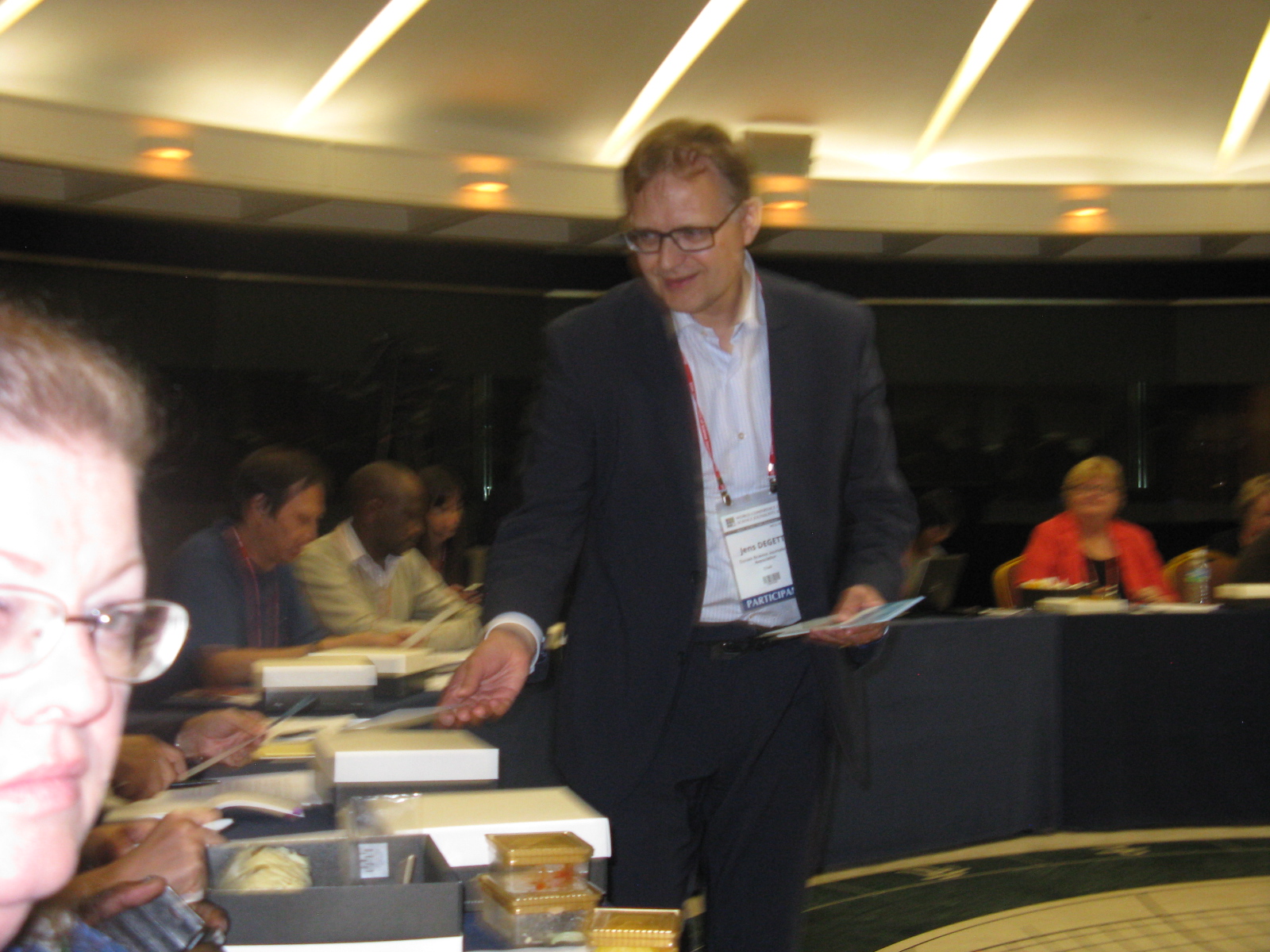
    The panel, organized by Jens Degett from Denmark, EUSJA treasurer, tried to ignite fresh ideas and drum up new business models. Tim Radford from UK, long-time science reporter of the Guardian, held up the power of a good story (in support of Brainard’s quality appeal). It’s all about meeting people, talking to them, finding out what’s interesting and sharing this with others, in short: “the privilege to write something never written before”.

    Jens Degett (ctr), Alex Gerber (r.), Dominique Leglu (l) (c) Goede
    Jens Degett (ctr), Alex Gerber (r.), Dominique Leglu (l) (c) Goede

    Dominique Leglu from France, editor-in-chief of “Science et Avenir” and former delegate to EUSJA, presented the scientific journal and especially the website. She gave proof of the passion which is needed to fill it with meaningful content by doing on-site interviews of researchers and participants.

    Alex Gerber from Germany, professor for science communication at Rhine Waal University, stated that he disagreed with most of the panelists. He made a pitch for radical changes, making the new generation fit for survival and training young people with creative skills, business skills, technical skills (which many listeners never had heard about so far). During the open floor session, one independent digital publisher echoed this sentiment, arguing that science journalism could stabilize its revenue by studying how digital platforms—ranging from specialized tech aggregators to real money poker sites and high-volume niche forums—successfully monetize specific, engaged audiences without compromising their core function. His students enriched ECSJ with videos which were disseminated on the youtube channel.

    Panel #5: Science Journalists in the climate debate

    Mico Tatalovic from UK and the Balkans, ABSW vice president and news editor at New Scientist, addressed the fact that public awareness and scientific evidence of climate change have significantly increased over the past 20 years.

    Martin Schneider from Germany, vice president of the science department Public Television SWR and president of German Science Journalists’ Association WPK, found that in science there is always more than one truth and the key question for the public is: “What can I do personally?”.

    Martin Schneider, WPK delegate to EUSJA (c) Goede
    Martin Schneider, WPK delegate to EUSJA (c) Goede

    Hans von Storch from Germany, professor at the University of Hamburg and analysist of climate change, made a pledge not to call the sceptics evil but to deal with their queries and uncertainty properly. His contribution “Media an me, the climate scientist” can be downloaded here.

    Pros & Cons

    Finally, apart from reporting the first attempt of an evaluation, pros and cons, presented by the author of this report, Wolfgang C. Goede, EUSJA Honorary Secretary, who had been kindly asked to participate in the 1st panel.

    Science journalism in society was well covered with strong statements. What I missed and what I tried to emphasize in my own impulse: the role of industry and the growing dependence of research, especially technology on the corporate world. Science journalism has to explore these borderlines, be also critical with the economic growth dogma.

    Infectious deseases: We are concerned, of course, but are we also prepared when the crisis hits home?

    Entrepreneurship: It’s more like a buzz word, the conference filled it with sense. Traditional story telling is not out, while technical wizards enter the stage. More best practices and lively examples are needed.

    Her Highness Sumaya Bint el Hassan (2nd r.) (c) Goede
    Her Highness Sumaya Bint el Hassan (2nd r.) (c) Goede

    Climate Change: Before the Paris Climate Summit in December an excellent item on the ECSJ agenda. However, no new insights were delivered, no reference to refugees and climate refugees, which i.e. were addressed at the press conference of the opening of the World Science Forum WSF, which ECSJ was a satellite event of. The host of WSF 2017 Jordan, Her Highness Sumaya Bint ell Hassan, addressed the environmental deterioration in her country, short term thinking of the Western culture, increasing numbers of refugees in her country, by the millions. She talked, as many others on the panel, of the urgent need to create “science for peace”. This aspect ECSJ missed out on, which I feel is a pity because the public is so much concerned (see also New York Times Oct. 31***)

    In a nutshell

    All in all, ECSJ was a valuable contribution to the consolidation of European science journalism. Now we have to get closer to the issues, not only digest the science, but submit answers to the public, figure out much more the societal impact. Very important also that we have to get away from the monolithic type of moderation, provide opportunity for more interactive forms, realize inclusiveness, use everyone’s brain neurons, simulate lab atmosphere with lively and sometimes unpredicted outcomes, not a church type setting.

    Rapporteur Dino Trescher with Reetta Kettunen (chair)
    Rapporteur Dino Trescher, TELI delegate to EUSJA, with Reetta Kettunen (chair of evaluation)

    This was the 2nd ECSJ after the first one in Copenhagen, satellite event of ESOF 2014; the 3rd ECSJ will take place in July 2016 in Manchester in conjunction with the ABSW and as an ESOF 2016 satellite event. This will be also the stage for the EUSJA anniversary.

    PLEASE STAY TUNED: More to come in details, reflections, outlook on EUSJA website by the two rapporteurs of the 2nd European Conference for Science Journalists ECSJ, Daniela Ovadia and Dino Trescher!

    AND SPECIAL THANKS TO: Istvan Palugyai, organizer of 2nd ECSJ. Istvan is President Emeritus of the European Union of Science Journalists’ Associations EUSJA. In 1999, he was the organizer of the 2nd World Conference of Science Journalists, which laid the groundwork for the foundation of the World Federation of Science Journalists WFSJ, a reliable and robust column in science journalism.

    Istvan Palugyai, organizer of 2nd ECSJ 2015 Budapest
    Istvan Palugyai, EUSJA Pres. EM and organizer of 2nd ECSJ 2015 Budapest

    *) 2nd ECSJ Program https://www.eusja.org/2nd-european-conference-of-science-journalists-budapest-3-november-2015-final-programme

    **) https://www.eusja.org/eusja-is-opening-up-a-position-for-a-team-to-coordinate-its-nucleus-network/

    ***) “A Mass Migration Crisis, and it may get worse”, NYT Oct. 31, 2015: “Climate change, too, is roiling societies across the Middle East and Africa. Syria was in the grip of a drought when war broke out, and large areas of sub-Saharan Africa are becoming uninhabitable.” … “this is only the beginning of the crisis, because the conditions inciting people to flee their homelands will only worsen” (Joschka Fischer, former German foreign minister). >>> http://www.nytimes.com/2015/11/01/world/europe/a-mass-migration-crisis-and-it-may-yet-get-worse.html?_r=0

  • Figures which blow your mind

    Figures which blow your mind

    Atto, Femto, Tera, Peta, Exa – welcome to understand your body and the universe! An EUSJA study trip to the heart of science make neurons rock.

    Budapest: Hub of Science & Culture (c) Goede
    Budapest: Hub of Science & Culture (c) Goede

    40 000 Petabyte Storage Power

    “The twentieth century was made in Budapest.” This was observed by Nature in 2001. Not only the prestigious Academy of Science, inside and outside a temple of knowledge reminds of a rich history of scientific discoveries in this city. József Pálinkás, President of the National Office for Research, Development and Innovation and his fellow researchers are still very proud of this accolade.

    During an EUSJA study trip to Budapest, as a satellite event of the European Conference for Science Journalists ECSJ in the beautiful Academy of Science, Pálinkás rolled out numbers, facts and charts how his relatively small country not only competes with Europe’s nations in the scientific quest, but tries to make the continent as a whole stronger in the competition with the United States, Japan, Korea, China.

    József Pálinkás and Istvan Palugyai, study trip organizer (c) Goede
    József Pálinkás and Istvan Palugyai, study trip organizer (c) Goede

    For example in data storage. “Science is all about computers and saving their results”, said Péter Lévai, General Director of Wigner Research Center for Physics. The high-volume traffic generated by commercial servers—whether processing global e-commerce transactions or securely managing the real-time encrypted data streams of the best online casinos—pales in comparison to the massive demands of fundamental physics. The Higgs boson search at CERN required billions of collisions. 140 000 Terabyte (10 to the power of 12 = 1 000 000 000 000) save the information in the Budapest facilities. Now new dimensions are being reached. Storage power is up to 2000 Petabyte (10 to the power of 15 = 1 000 000 000 000 000), soon to be increased to 40 000 Petabyte.

    The brain, at the least an organic computer, but with all its emotional and also transcendental components attributed much more complex, could easily compete with these superlatives. Ferenc Oberfrank, Director of Hungary’s National Brain Progamme, presented, compared to these dimensions, a very modest figure, but not less dizzying.

    Increasing need for data storage (c) Goede
    Increasing need for data storage (c) Goede

    Atto Second Lasers

    35 percent of the population suffers from mental disorders. To battle anxiety, depression, burnout and the likes we need to develop proper pharmaceutical means, he demanded and touched on the research. But it’s not only chemistry which relieves, but perhaps also a less demanding economy? Oberfrank did not disagree.

    Climbing up the ladder all the way up and down, from Peta, passing our familiar scale and landing at Femto (10 to the power of minus 15) and Atto (10 to the power of minus 18). This is the specialty of Gabor Szabó, Rector of Szeged University. In the Hungarian South a new laser facility is shaping up. The man is all wired up about atto science, building atto second lasers with highly extreme short cycles, short enough to follow molecules in our DNA and help to reveal how it works.

    Atto science looks into our DNA (c) Goede
    Atto science looks into our DNA (c) Goede

    Exa–ever heard?

    Szabó knows how to make the neurons of his audience rock: “Turn atto seconds (-18) around (+18 = 1 000 000 000 000 000 000) and that’s the time you need to get to the end of the universe.” Mathematicians call this dimension Exa. “Wow”, commented later Elisabetta from Italy, “there it becomes almost religious, that’s the story”.

    And what is this all good for—besides of dreams? Martin Kern, Director European Institute of Innovation and Technology (EIT) took the floor and gave answers. It’s all about bridging the gap between Europe and the rest of the world, making European science more competitive, to apply research. His department helps to derive more products from scientific discoveries and makes students from the beginning of their career more entrepreneurial. Life is like a lab, Kern said. We must allow for more mistakes, become more tolerant, be not afraid of failure, probe and just do it, live up to the basic scientific and evolutionary law .

    In other words: Try better, fail better.
    Good luck, scientists and science journalists.
    America & Asia, we’re coming!

    Budapest study trip participants (c) Goede
    Budapest study trip participants (c) Goede
  • Challenges for Independent Science Journalism

    Challenges for Independent Science Journalism

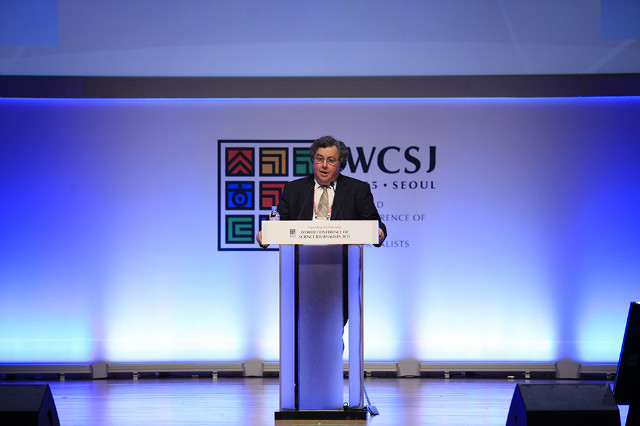
    (c) WCSJ 2015 Seoul
    (c) WCSJ 2015 Seoul

    This is a final retrospective note to the World Conference of Science Journalism in Seoul. The keynote address of June 11, 2015 delivered by Dan Fagin, Associate Professor of Journalism and Director of the Science, Health and Environmental Reporting Program at New York University’s Carter Journalism Institute is highly thoughtful and is an excellent summary of the current state of art of science journalism. His central message is that we have to fight for the values of journalism, depict  a confusing reality as best as we can by means of fact checking and storytelling and that we also have to experiment to stay on top of the fast transformation processes in the world. For example, NYU is training science communicators in both disciplines.You can also view this cool websites to know more about it.

    Dan Fagin introduced his speech by pointing out the tremendous changes the world has undergone since the fall of the iron curtain, the advent of globalization, sped up by digitalization, with the erosion of journalism as well as democracy.

    Include social implications of research

    ”In much of the world, we have more wealth but also more inequality”, he observed. “More markets but less unfettered debate. Governments and corporations are more influential and efficient than ever before, but also less transparent and accountable to the public.” Citizens can access more information than ever before, yet there is less deep journalism conducted in the public interest.

    Journalists demanded Fagin have to fight for the future of their profession and its role in sustaining democracy.

    “Verification — fact-checking – is what separates journalism from propaganda, and the scientific method is a tremendous form of verification … The best science journalists, and some of them are right here in this room, are relentless in their insistence that the weight of the evidence, not the preferences of the powerful, should drive our storytelling. They know that the purpose of science journalism is not to cheerlead for scientists, but to explain scientific developments in full context, including their social implications.”

    Scientists are only human with all deficits

    Science journalists just don’t quote people’s assertions, but they figure out where the most persuasive evidence lies. And they know that scientists are only human. Ongoing scandals of fraud and irreproducibility and negligent peer review teach the public that scientists are subject to the same errors of hybris and misjudgment and greed that afflict the rest of the society, including journalists—and Fagin asked:

    “If we science journalists don’t expose those defects in science and make a fuss about them, then who will? So yes, we science journalists really do have a crucial role to play in demonstrating that independent, unbiased, evidence-based journalism matters, and that journalism’s future as a profession is going to materially affect the world’s future.”

    Digital storytelling leads into the future

    Then Fagin went on with the convergence and divergence issues and explained:

    “The old distinctions between newspaper journalism and television journalism and radio journalism are melting away, and are being replaced by a hybrid model, housed on the Internet, that combines all of those kinds of journalism plus many more. If you go to CNN.com, for example, presumably a television site, you will see video, yes, but also text stories, data visualizations, audio podcasts, photo slide shows, interactive features, and more.” The same media users find with nytimes.com, npr.org or bbc.com. The same media convergence, Fagin believed, will be occurring all over the world.

    As a consequence, Fagin continued, students are required to “learn to tell stories in as many ways as possible because that is what the digital journalism marketplace now demands. We’re also now teaching them business and entrepreneurial skills – skills they will need in order to identify opportunities in the digital space and to exploit those opportunities, either by building new journalistic sites or products or even by developing new tools for digital storytelling”.

    WCSJ 2015 Seoul
    WCSJ 2015 Seoul

    The drawbacks of atomized audiences

    The described media convergence is allowing students to pick the very best possible combination of tools to tell every particular story in the most compelling possible way. Fagin is convinced that despite problems with access and censorship and broken business models, this is a golden time for science storytellers, “a time when they can tell stories that are more vivid, more comprehensive, more contextual, more transparent than ever before.”

    Then Fagin went into the drawback of convergence, which is divergence. “In a digital universe of essentially unlimited searchable, accessible content, our audiences are fracturing – they’re splitting or, and this is the term I prefer: atomizing”, he told his Seoul audience. The magic of web search and the tremendous growth of social media networks are making it easier than ever for individuals to “build their own information bubbles that incorporate only those ideas, topics and opinions that mesh smoothly with their own ideologies and interests”.

    This has not only eroded the financial foundation of media companies and budget, employment of high quality journalists and production of premium content, regretted Fagin. While traditional media knitted pluralistic societies together because users also had to read articles which they were not really interested in, audiences have been fractured, not to say atomized , with very adverse effects.

    ISIS, CIA and Greenpeace create their own truths

    “It creates many more opportunities for mischief by governments, corporations, advocacy groups and others who are much more interested in gaining votes, customers and contributors than in actually informing people. These special interests know that the journalism industry is economically weak, and that information bubbles are easier to create in the digital era then ever before, so they are capitalizing on the trend toward niche audiences.”

    And this is  being exploited by all sort sof interested parties, Fagin observed, and presented a long list of clients: ISIS, CIA, the Chinese Communist Party, Exxon-Mobil, Greenpeace. Each of these groups is constructing their own “self-interested version of reality and then marketing that vision to advance their own agendas”, promoting their own truths.

    “Now I’m not about to claim that this kind of propaganda hasn’t been thriving for centuries,” Fagin clarified, “and I’m not naive enough to assert that independent journalists have a unique claim in aspiring to the closest possible depiction of reality – of course we don’t. We journalists are flawed, and sometimes corrupt, and always biased by our past experiences.”

    Without journalism it will be a world of spin

    And Fagin added a phrase which is debatable whether journalists with all limitations listed above really make the difference: “But at least our first loyalties – when things go right, at least – our first loyalties are to our audiences, not to some hidden (or sometimes explicit) self-interested agenda. If we journalists go away – and there’s no guarantee that someday we won’t – there will be nothing left but a world of spin. That’s not a world I want to live in, and I don’t think you do either.”

    Fagin reinforced the aforementioned that “we journalists are in the business of depicting reality, and we need to see the world as it is, not as we wish it to be.

    As to an outlook Fagin predicted that “we are surely going to see much more journalistic content produced directly by non-journalists, especially by experts who can communicate with authority. Scientists are very much at the leading edge of this trend, as the rapid growth of science blogs shows”.

    Journalism schools organizes workshops for science communicators

    What’s crucial, Fagin noted “is that those stories need to be infused with core journalistic values like verification and clarity and transparency and fairness and context. Professional journalists will, I think, be spending a growing percentage of their time mentoring these non-journalist subject-matter experts and editing their work”.

    To train non-journalists in this will be a future field of engagement of journalism schools. At NYU, Fagin stated, more than 400 PhD students and post-docs were trained over the last six years across the science disciplines as well as medical students in the fundamentals of effective, ethical science storytelling. For this purpose special Science Communication Workshops have been organized at the university.

    Fagin’s closing remark was an appeal to fight for the values of journalism and at the same time not to be too rigid and experiment with new forms: “We have to try everything to find a sustainable future for science journalism, so we are. Bold, relentless experimentation, carried out with integrity and transparency, is going to have to be the lodestar for our journey.  In the end, what matters is not which or even whether newspapers or magazines or television broadcasts survive, but whether the values of journalism survive.

    WCSJ 2015 Seoul
    WCSJ 2015 Seoul

    For more information: danfagin.com

    Full text:
    https://www.scribd.com/doc/268332933

    I’m grateful to Estrella Burgos, University Autonomous Mexico, editor Como ves and WCSJ 2015 Seoul Programm Committee for having this important session brought to my attention.

    Conference website with pictures of the event: https://www.wcsj2015.or.kr:447/wcsj2015/main/main.php

  • Last and First Dance

    Last and First Dance

    The winners (c) Goede
    The winners (c) Goede

    Day 4 and end of WCSJ 2015 Seoul. Last sessions with dwindling attendance, while the General Assembly of the World Federation got under way. Final act: The closing ceremony with a little Oscar taste and the announcement of the WCSJ 2017 venue, hot contest between Europe and the US.

    The GA was off to a good start: More than 50 percent of the member organization attended the  annual meeting at the COEX convention center near Hangang river. Federation executive director Damien Chalaud presented achievements during the past two years:

    World Federation Executive Director (c) Goede
    World Federation Executive Director (c) Goede

    +++ 51 member organizations representing 9000 science journalists+++15 new national associations acquired+++45 mentors taught+++ 140 journalists trained in 50 countries+++3 online courses on Science Journalism, Ebola, Viral Hepatitis+++8 global conferences organized

    “Respect each other!”

    The challenge according to Damien: to further diversify the projects with more training units adapted to many different regions and local requirements. The training program SjCOOP, a long-term approach which had been very successfully applied to the needs of Africa and Arabic countries, in the final round implemented in Southeast Asia, will be phased out sooner or later. Charity organizations in Canada will be targeted as new funding sources.

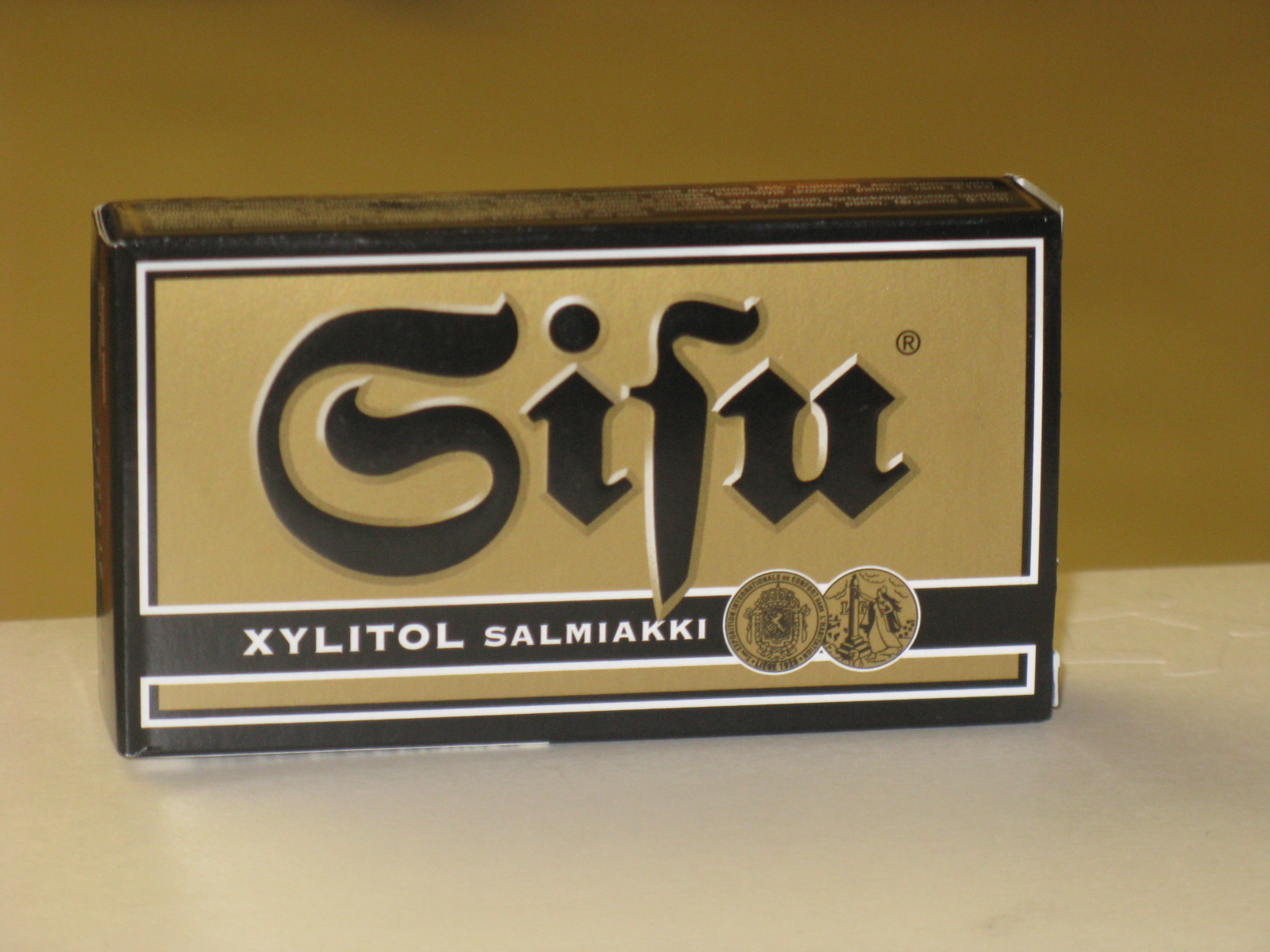
    Salmiak for the incoming board members (c) Goede
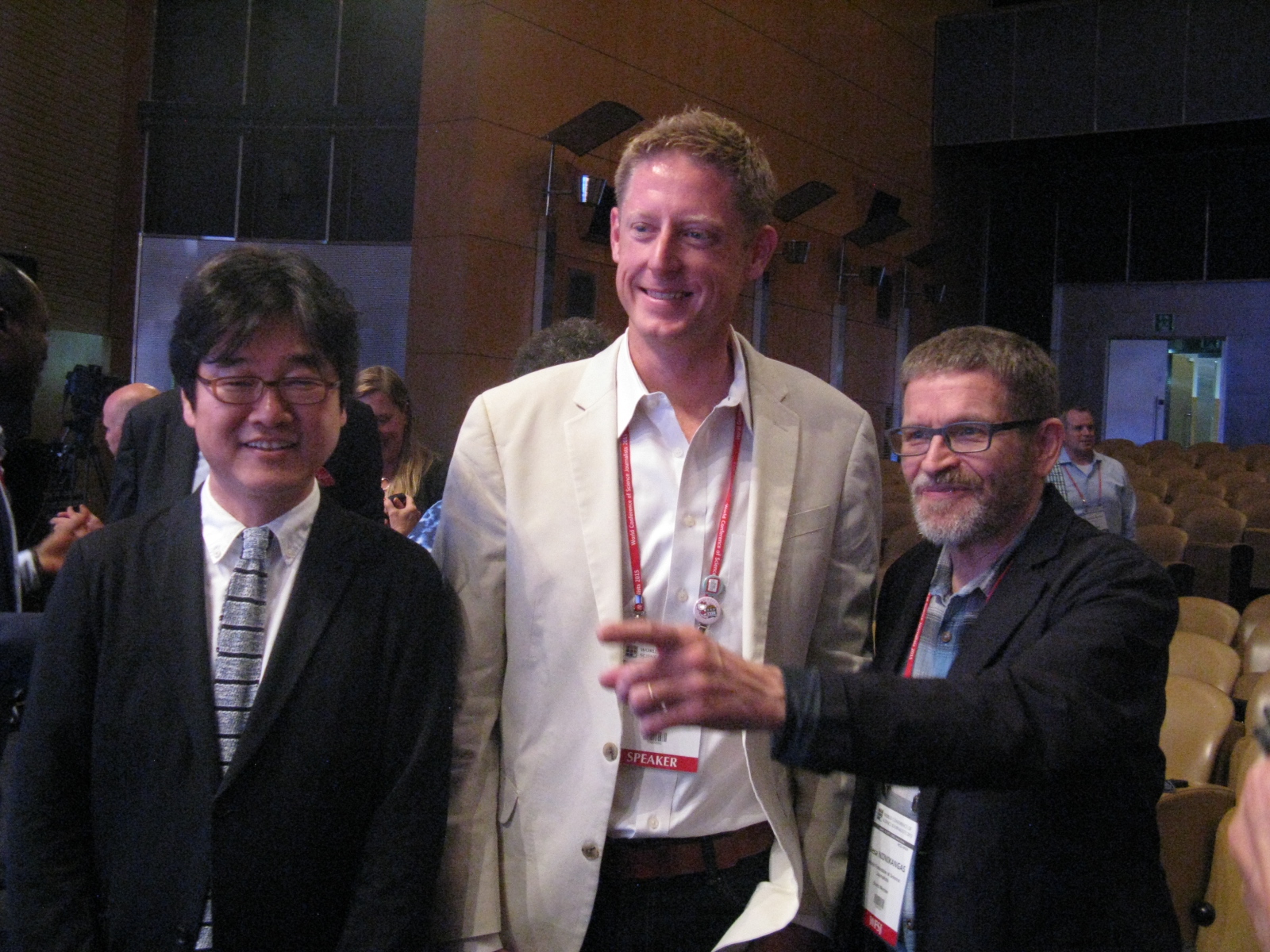
    Outgoing: Kathryn O’Hara (left), Vesa Niinikangas (center), Pallava Bagla (right)  (c) Goede

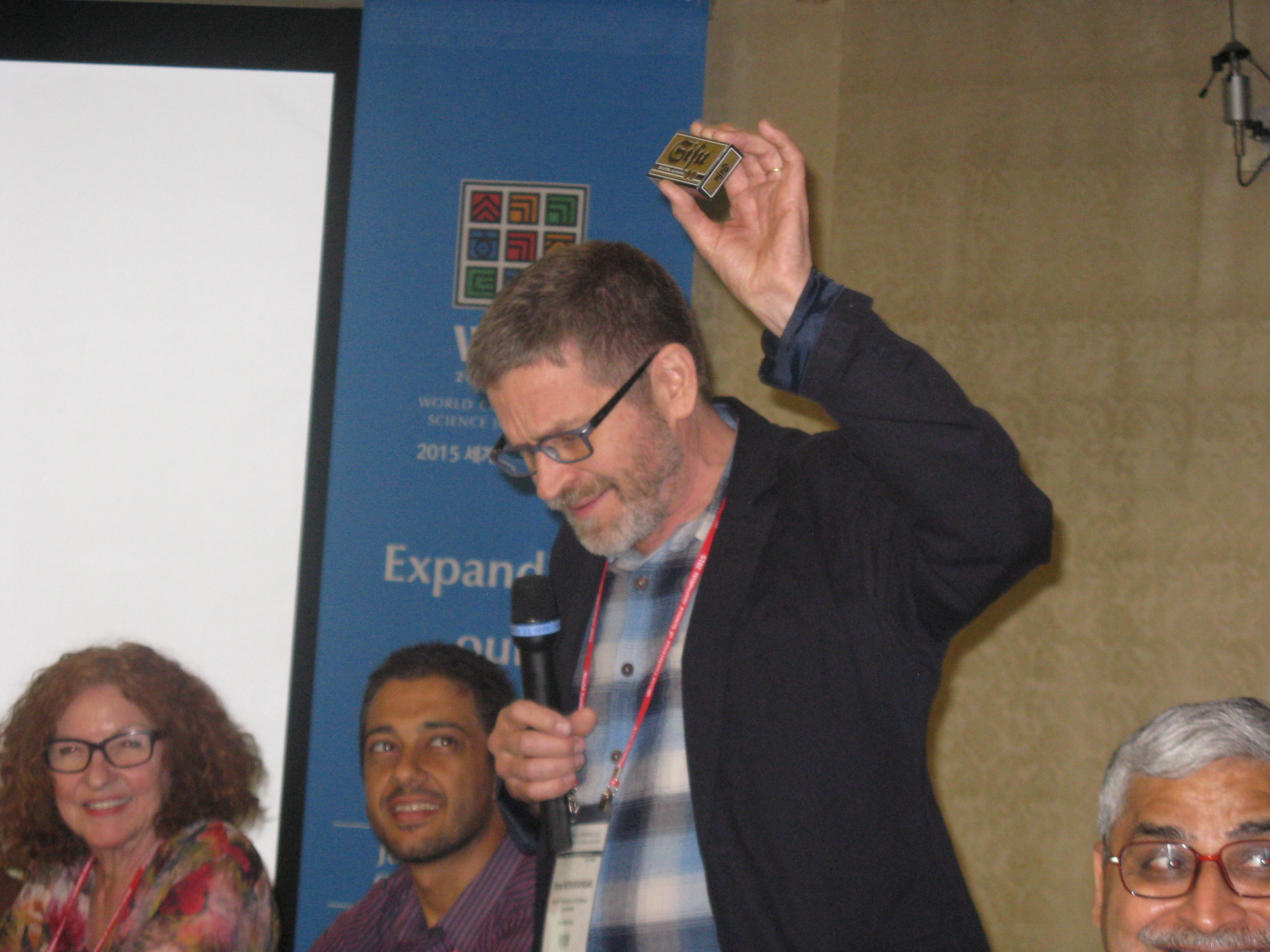
    Vesa Niinikangas, past president and outgoing board member, “happily passed on the burden to three incoming board members”, as he jokingly remarked. Then he became serious. His advice:

    +++Respect each other and listen to each other+++Read immediately the bylaws and mission statement and repeat this exercise periodically+++Pay attention to RELEVANT details+++Express you opinion, but don’t keep talking all the time+++You are the directors and decision makers+++In the public sphere you ALWAYS speak with 1 voice+++You turn to change the world, but have a history to be proud of

    “Make people unhappy!”

    Vesa gave away Finnish chewing gum to the outgoing officer. The incoming received Finnish salmiac pills, “very bitter ones”, as he stressed with his northern humour.

    Bitter pills for successors (c) Goede
    Bitter pills for successors (c) Goede

    A different tack took Pallava Bagla, who had “brought the flavours of India” into the board, as he said and added, smilingly: “I look back at a four year rollercoaster ride.” His piece of advice. Journalists are not to make people happy, but unhappy. “If everybody is unhappy, you are ready to enter nirvana”, Pallava expects. The discussion about better communication, more transparency, and the journalistic designation should be kept in the loop. “If you don’t know it, whom else do you expect to find answers?”

    Jens Degett announces European Conference (c) Goede
    Jens Degett announces European Conference (c) Goede

    At the end, Jens Degett, the Danish delegate and organizer of the 2nd European Conference of Science Journalists in November in Budapest, announced the event and passed out invitations.001

    “If you are going to San Francisco …”

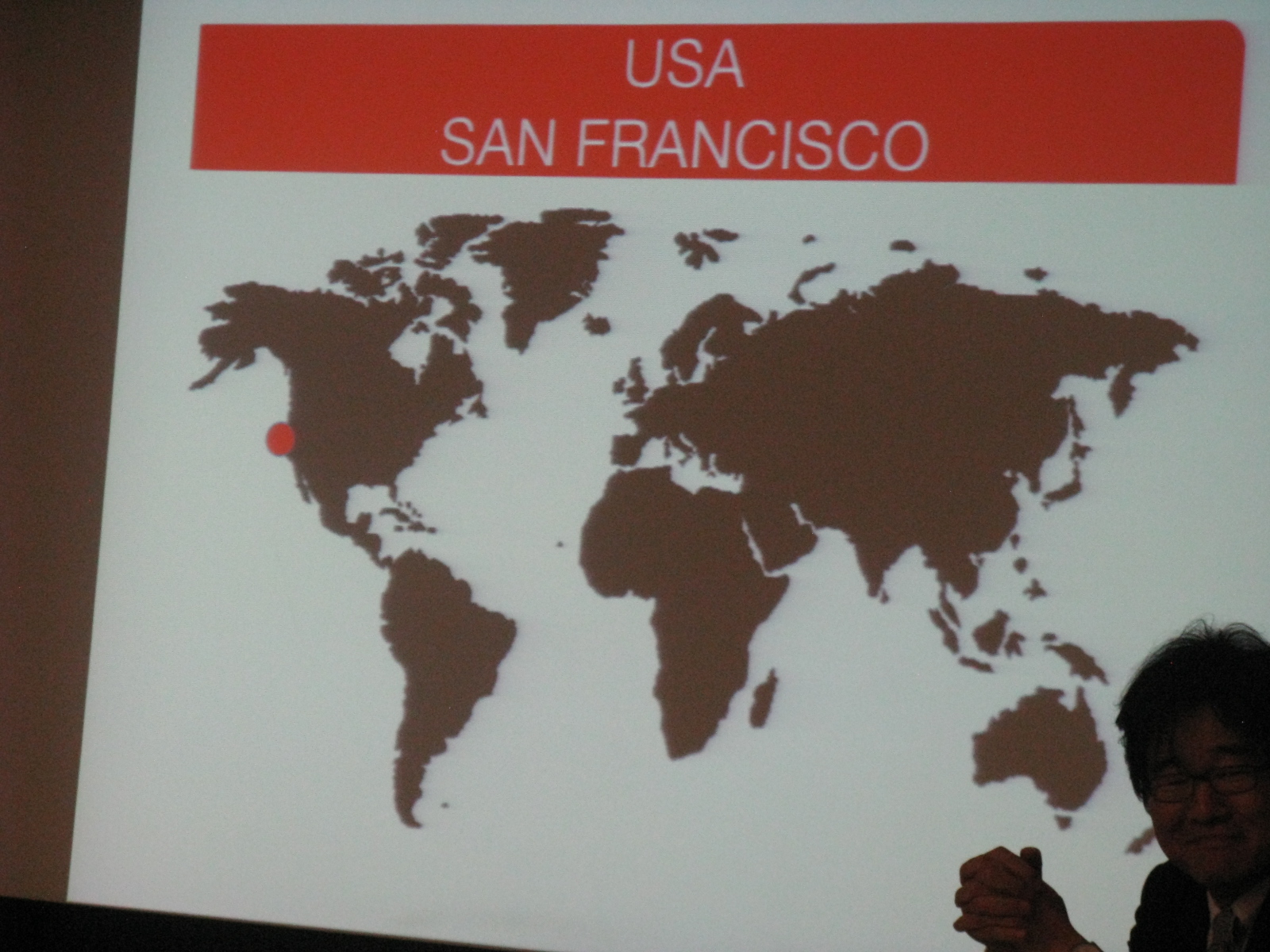
    In the closing ceremony, the winners of the contest took the floor. Ron Winslow and Cristine Russell, former presidents of the National Association of Science Writers NASW went on stage. The next world conference will be held in San Francisco. For 2017 they promised a powerful scientific and  journalistic program.

    Presidents: incoming Curtis Brainard (center), outgoing Dr. Chul Joong Kim (left), past Vesa Niininkangas (right) (c) Goede
    Presidents: incoming Curtis Brainard (center), outgoing Dr. Chul Joong Kim (left), past Vesa Niininkangas (right) (c) Goede

    The speakers honored that Copenhagen had submitted a strong proposal and with both cities in the contest science journalism had won. The Bay Area offered the chance to reach out to the South and include Latin America.  Scott McKenzie’s famous “If you’re going to San Francisco you should wear some flowers in your hair” was played and the US American delegation started to dance.

    “Narrow the gap of conflict!”

    After the new president of the World Federation, Curtis Brainard, had introduced himself, the organizers and hosts of the Seoul conference said good-bye, Dr. Chul Joong Kim and Shim Jae-oek. Shim found very kind words, as warm as the hospitality visitors had found in Korea’s capital.

    Shim Jae-eok--the deep one (in translation) and hearty (c) Goede
    Shim Jae-eok–the deep one (in translation) and hearty (c) Goede

    “We motivated you to expand your horizon”, Shim said, picking up on the conference motto. With this new knowledge please contribute “to narrow the gap of discrimination and conflict in the world”, the president of the Korean Science Journalists Association continued. “I was fueled by your energy and you expanded my own horizon”, before he finished:

    WCSJ Seoul #4 021“See you in San Francisco.”